Collaborative robots, ultrasonic acoustic energy, picodroplet technology, and cloud computing are among the technologies advancing liquid handling—simplifying workflows and raising efficiency and productivity levels. These new, often automated, and efficient solutions are frequently enabled by connections—between human operators and robots, among complementary technologies, or via the cloud.
Working with robots
Massachusetts-based HighRes Biosolutions develops robotic systems that work alongside scientists to automate laboratory tasks. According to CEO Peter Harris, the majority of their systems integrate collaborative robotic components and therefore are able to work safely with scientists. “If the robot collides with a person, its force is not great, and it knows to stop. You can typically just reach out your hand and stop a collaborative robot from moving, or grab it and teach it a new location or path to follow. As a result, people and robots can work together to perform work.”
HighRes’ goal is to drive productivity and efficiency in drug discovery by having people do what people do best, and robots do what robots do best. “Humans are incredibly versatile, have the best CPU ever made, the best gripper ever made, and some pretty astonishingly good machine vision,” Harris explains. “If you need to make adjustments to a workflow, a human watching things happen can make quick, powerful observations, reach in and tweak things quickly, etc. On the other hand, robots are relentless and repetitive. They do not stop. You want a robot to do repetitive tasks, precisely and continuously.”
Collaborative robots allow the best of both worlds…
Collaborative robotic technology allows the best of both worlds—delivering unprecedented efficiency while taking over the often mundane, repetitive tasks; enabling scientists to focus on the truly scientific aspects of discovery. This human and robot collaboration is exemplified by a number of HighRes Biosolutions’ systems.
Recently, the company launched the Prime, an advanced automated liquid handler. Unlike traditional systems, the Prime stands vertically to save space; can be easily moved or integrated into any system; and utilizes two, state-of-the-art robots that manage aspirating, dispensing and deck loading simultaneously. “We believe Prime solves many issues with traditional liquid handlers through some fundamentally different design choices. Essentially, it has the ability to achieve very high levels of experimental throughput, in both a much smaller footprint and with mobility and modularity built in,” says Harris.
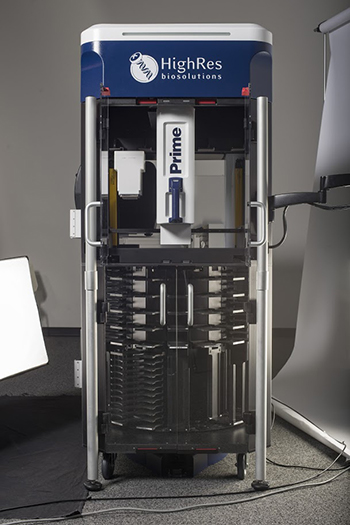 One of the core pillars of HighRes’ strategy is to continually expand the range of laboratory workflows where automation can be effective. “While many areas of scientific research have been touched by automation, other areas remain less developed,” Harris notes. Generally speaking, the lower-volume activities with higher degrees of configuration have not been penetrated as much as high-volume repetitive activities, like high-throughput screening. In many ways, this is the result of the way automation solutions have been crafted, and some associated limits therein.”
Image: Prime is a fully integrated system that brings together liquid handling automation, labware movement and storage, as well as device and informatics integration in a compact platform. Image courtesy of HighRes biosolutions.
Managing samples with ultrasonic acoustic energy
Labcyte’s acoustic liquid handling technology has already been deployed across many areas of life science research and drug discovery. The company is actively working on validating new applications as well as creating new workflows. In its recent collaboration with AstraZeneca, Brooks Life Sciences, and Titian Software, Labcyte’s acoustic liquid dispensing technology was applied to pharmaceutical sample management and screening programs for the dispensing of reagents in a wide variety of molecular and cellular assays.
Their complete solution includes automated storage systems that allow for rapid retrieval of FluidX™ AcoustiX™ Sample Tubes, both supplied by Brooks. Racked tubes are then transferred to Labcyte’s AccessTM Dual Robot Sytem (DRS) workstation where the Labcyte Echo® 655T Liquid Handler, based on acoustic droplet ejection technology, transfers samples directly from AcoustiX tubes into assay-ready plates for high-throughput screening applications. Software for the system is provided by Titian.
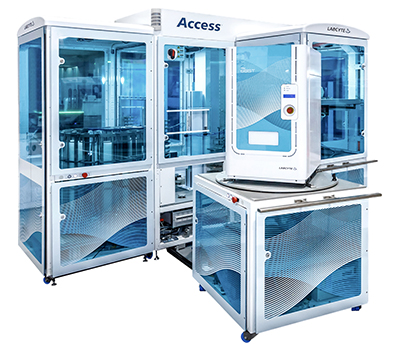 “The collaboration was born out of discussions driven by AstraZeneca regarding their vision for a next-generation compound management and screening infrastructure. They were vocal about their desire to work with partners to leverage their collective experiences, expertise, and technologies to develop innovative solutions. As they were already working closely with Labcyte for their existing compound management liquid-handling needs, and given the highly enabling nature of acoustic liquid handling to transfer very small amounts of sample very rapidly, AstraZeneca started discussing their ideas with Labcyte,” Randy Dyer, director of product management at Labcyte, explains.
Image: Labcyte's Access Laboratory Workstations are modular, flexible solutions that easily scale when needed.
Performing single-cell analysis with picodroplet technology
In another example of companies working together to solve a problem, Sphere Fluidics tapped into the engineering and product design expertise of TTP plc in order to develop a single-cell analysis system based on Sphere’s novel microfluidic picodroplet technology. The partners created a single-cell dispensing technology that they say provided the missing link in the sample-to-well-plate solution. Sphere has identified a number of applications for the resulting product, Cyto-Mine®, such as antibody discovery from single cells, cell line development, and monoclonality assurance. TTP describes this system as “an integrated device to automatically perform all of the techniques routinely used in the biopharma discovery and development workflow in a single GLP compliant system that fits in a biosafety cabinet.” Using picodroplet technology, this system can deliver tens of millions of tests in one day.
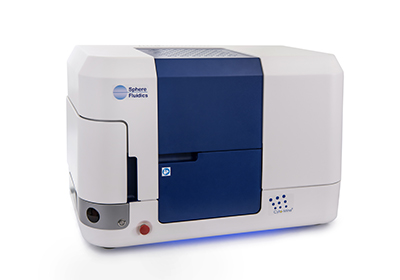 According to Frank Craig, Ph.D., CEO at Sphere Fluidics, Cyto-Mine can screen up to 40 million primary cells per run per working day. “For the first time, this enables interrogation of antibody generation from the entire B-cell population in a murine sample. This is far superior to clone pickers or other approaches. The technique is rapid (can detect antibody production in 15 minutes) and sensitive.”
Cyto-Mine also includes integrated monoclonality assurance in which four images are taken of each picodroplet/single cell being dispensed. Monoclonality assurance is required for FDA approval, and current techniques often involve manual limiting dilution or use of a number of different robots and plates imagers, Craig explains.
Image: Cyto-Mine® can screen up to 40 million primary cells per run per working day. Image courtesy of Sphere Fluidics.
Connecting with smart devices using the Cloud
Gilson recently launched Gilson Connect, a cloud-connected platform that powers Bluetooth®-enabled, smart liquid-handling devices designed to help scientists achieve verifiable science. The first smart products include TRACKMAN® Connected and PIPETMAN® M Connected, lab instruments that give scientists the ability to record and track pipette performance data in real-time and transmit them to sciNote, a free, open-source electronic lab notebook.
Biocompare’s Liquid Handling Search Tool
Find, compare and review liquid handling
systems from different suppliers Search
“Gilson is bringing the potential of the Internet of Things to the lab, creating a new standard of verifiable science and helping researchers focus on doing actual science instead of data management,” says Nicolas Paris, Gilson’s CEO. “With the Gilson Connect platform, we envision a connected lab bench of the future in which all scientists have access to laboratory tools that communicate seamlessly with each other.”
In April, Gilson announced a partnership with Synthace to connect PIPETMAX to the cloud, which they say will make it easier to design and reproduce experiments. Antha software will help PIPETMAX users create, edit, and run their automated liquid-handling methods using drag-and-drop visual interface. By designing protocols with Antha, researchers can share highly optimized methods and practices with others, cutting out the time-intensive and often frustrating process of deducing protocols from research papers.