The limitations of traditional 2D cell culture systems have driven the development of more physiologically relevant 3D models that better mimic native tissue complexity and function. Among these advanced systems, organoids represent a significant breakthrough in recreating organ-specific characteristics in vitro. Their ability to model human tissue biology is transforming biomedical research and therapeutic development.
What are organoids?
Organoids are three-dimensional cell culture models derived from stem cells that self-organize and differentiate into structures recapitulating key features of their corresponding organs. In traditional 2D cultures, vessel attachment disrupts the structural organization and alters cell-cell and cell-extracellular matrix interactions normally found in native environments. 3D organoid models preserve the native tissue architecture and cellular microenvironment that is crucial for physiological relevance. These systems maintain complex multicellular structures, specialized functions, genetic stability, and cellular heterogeneity that more faithfully recreate in vivo biological conditions.
Organoids have become powerful tools in many areas, including developmental biology, drug discovery and development, and personalized therapies. They enable high-throughput screening of therapeutic candidates while providing more accurate predictions of drug responses compared to 2D conventional models. In preclinical studies, organoids improve assessments of both efficacy and toxicity, strengthening the translational pipeline from bench to clinic. They are increasingly central to personalized medicine approaches, where patient-derived cultures allow for more customization based on individual genetic and phenotypic profiles, potentially yielding more effective targeted therapies.
Organoid culture
The culture of organoids generally involve complex, multi-step processes designed to allow stem cells to self-organize into a 3D structure. While specific protocols vary depending on the target organ, the workflow can be summarized as a standardized progression from cell sourcing to long-term maintenance.
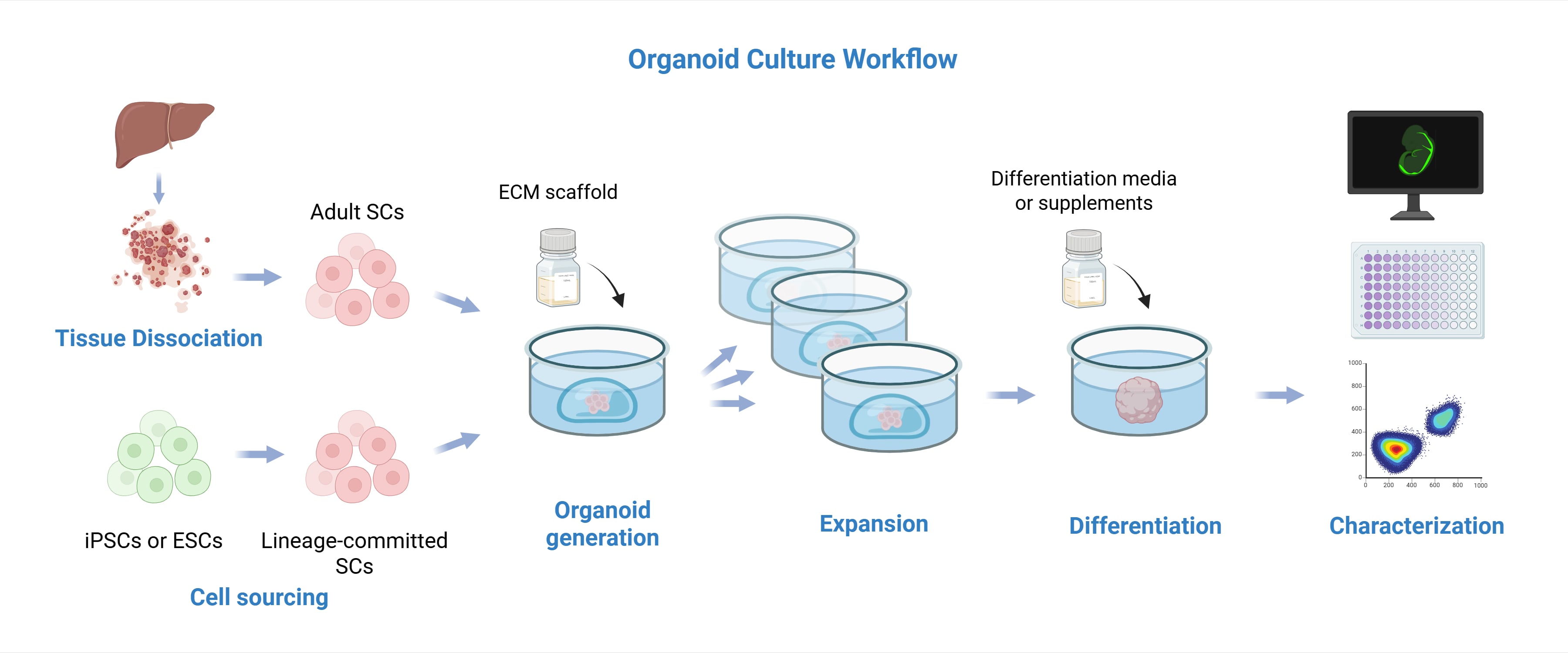
Created in BioRender. Estipona, D. (2026) https://BioRender.com/er7755i
Cell sourcing
Organoids are derived from either pluripotent stem cells (iPSCs or ESCs) or organ-specific adult stem cells (ASCs) isolated from fresh or frozen tissue biopsies. iPSCs must first undergo reprogramming to become capable of differentiating into specific organs, whereas ASCs are already lineage-committed. Organoids generated from ASCs are also often called Patient-Derived Organoids (PDOs), as these reflect patient-specific disease states.
Tissue dissociation
For tissue-derived organoids, the sample is first rinsed and finely minced into small pieces. Depending on the tissue type, enzymes (such as collagenase and dispase) are used to digest the ECM and release individual cells or small clusters. Mechanical dissociation, such as repeated pipetting, is also used to disrupt any remaining cell agglomerates to finally achieve single-cell suspension. Filtration and centrifugation can be performed for additional cleanup. Some sample types, such as tissues containing other neural, immune, vascular, or scaffolding cells, may need to undergo more rigorous cell isolation. Cell sorting procedures like MACS or FACS can be used to select more specific phenotypes.
Organoid generation
In the initial seeding and plating, isolated cells transition from a single-cell suspension to a structured 3D environment. A common method for organoid generation utilizes hydrogel scaffolds, which are designed to mimic natural ECM and support growth in 3D. ECM scaffolds used in organoid culture systems include Matrigel, collagen, hyaluronic acid, PEG, decellularized ECM, and composite hydrogels comprised of natural and synthetic components. The suspensions are plated as domes and overlayed with growth media supplemented with essential growth factors and inhibitors that support organoid formation. Other methods of organoid formation include scaffold-free self-aggregation, such as by hanging drop, ultra-low attachment vessels, and pellet culture.
Expansion and differentiation
The organoid culture is maintained by consistent medium exchange, generally every 2 to 3 days. As the organoids grow, they are passaged every 7 to 10 days by mechanically disrupting the domes or using enzymatic digestion. They are portioned into smaller fragments before re-embedding in fresh hydrogel for further expansion. Lineage-specific differentiation media is exchanged to initiate the differentiation of organoids into specific cell types. This often involves the addition of signaling activators or removal of differentiation inhibitors.
Organoid characterization
To validate the viability, composition, structural integrity, and physiological relevance of the matured organoids, there are several approaches to characterization. Specific phenotypic markers are assessed using methods such as fluorescence- or magnetic-based cell sorting, immunohistochemical and fluorescence staining, and RT-qPCR. To visualize the 3D architecture and dynamic processes, organoids are imaged using techniques such as confocal, light-sheet, and two-photon microscopy. To verify organ function, tissue-specific functional tests are used, including metabolic activity assays and cell-based assays, and drug response screening. Organoid culture can be further enhanced by incorporation with automated processes, live multi-sensor monitoring, high-throughput automated assays, and specialized liquid handling platforms.
Cryopreservation
For long-term storage, organoids are harvested, resuspended in freezing media stored in cryogenic freezer or liquid nitrogen. Freezing and thawing should follow an optimized cryopreservation and recovery procedure to ensure long-term viability.
Organoid culture media
There are diverse options for commercial 3D organoid culture media, which includes animal-derived basement membrane extracts, synthetic hydrogels, tissue-specific matrices, and specialized media kits. Basement membrane extracts (BME) are enriched with extracellular matrix proteins that promote 3D growth, such as laminin, collagen IV, and various growth factors. Such BME products include Matrigel (Corning), Cultrex BME (R&D Systems), and Matrigengel (ACROBiosystems). Synthetic and xeno-free hydrogels offer an animal-origin free option that can also help address batch variability. Some examples include Synthegel (Corning), VitroGel (TheWell Bioscience), and X-CLARITY (Logos Biosystems). Tissue-specific decellularized extracellular matrix (dECM) hydrogels are derived from specific organs and provide a highly specialized microenvironment. An example is TissueSpec and Multi-Organ Metastasis Kits (Xylyx Bio), which can be ideal for culturing organ-specific organoids. Culture media can often be supplied in a kit format, which includes more components beyond the structural matrix, such as expansion media and supplements. Specialized media kits can help support simplified, optimized, and reproducible organoid formation and growth.
Patient-derived organoids
Patient-derived organoids (PDOs) originate from adult stem cells (ASCs) isolated from patient tissues and are valuable models for recreating tissue-specific characteristics and disease phenotypes. As an organoid model, PDOs offer unique advantages in terms of physiological relevance for translational applications. Unlike 2D cultures, PDOs are able to retain patient-specific genomic and phenotypic characteristics over multiple passages. As 3D cancer models, they are better able to replicate tumor-specific architecture, cellular heterogeneity, and microenvironmental gradients across diverse cancer types.
Compared to other patient-specific xenograft models, PDOs are faster to generate, more scalable, and more ethically favorable. PDOs enable high-throughput drug screening and resistance modeling while guiding personalized treatment strategies. Advanced co-culture systems integrating PDOs with autologous immune cells or biomimetic microenvironments can be used to study complex tumor-stroma-immune interactions, expanding applications in immuno-oncology. Beyond cancer, organoids from toxicity-prone organs such as liver, kidney, and intestine also provide human-relevant preclinical safety models that can complement or replace animal testing.
In comparison to iPSC-derived organoids, PDOs derived from adult stem cells are already committed to organ-specific differentiation, simplifying an initial stage in organoid culture. However, PDOs are more sensitive to the quality of the tissue source. Low-cellularity biopsies, necrotic tissue, or samples with excessive stromal content can lead to poor organoid viability, impacting downstream applications. Tumor-derived PDOs may also need specific media formulations to ensure that healthy cells do not outcompete the cancer cells. Additionally, the genomic background will differ across each patient sample, making standardization more challenging than with iPSC-based models.
Tumor organoids
Tumor organoids, sometimes referred to as tumoroids, recreate histopathological, genetic, and phenotypic characteristics of patient tumors by reassembling dissociated cancer cells. These models can be established from diverse sources including small biopsies, bodily fluids such as urine or cervical smears, and even circulating tumor cells. Tumor organoids preserve intratumoral heterogeneity and subclonal architecture, including cancer stem cells and stromal populations, making them valuable in vitro tools for modeling native tumor biology.
Tumor organoids can differ fundamentally from their normal counterparts in both architecture and growth dynamics. While healthy organoids form single-layered, cyst-like structures, tumor organoids often form glandular, solid, and poorly cohesive architectures that reflect the histological and cellular heterogeneity of the source tumor. Tumor organoids frequently display distinctive radial growth gradients absent in healthy cultures. Paradoxically, cancer organoids often proliferate more slowly than normal organoids, complicating culture establishment, as healthy cells can sometimes dominate heterogeneous cultures. This necessitates careful selection of pure tumor source material or implementation of selective culture conditions that preferentially support tumor cell expansion over normal cells.
Cerebral organoids
Often referred to as "mini-brains," brain or cerebral organoids are designed to recreate the architectural, cellular, and functional characteristics of the human brain in a 3D in vitro environment. Cerebral organoids have wide applications in human studies, including brain development, neurodevelopmental disorders, neurodegeneration, environmental effects, infectious disease, drug discovery, and regenerative medicine.
Brain organoids are derived from iPSCs or ESCs as human brain samples are generally inaccessible for isolating ASCs. Thus, starting from pluripotent cells, the culture process is more complex and time-consuming compared to other organs. Cerebral organoid growth proceeds from 3D embryoid body (EB) formation, neural induction, differentiation, until maturation. The culture can follow an unguided protocol, in which stem cells undergo spontaneous differentiation and morphogenesis without extrinsic factors to form a miniature cluster of diverse brain regions and cell types within a single structure. In contrast, guided protocols use a precise cocktail of morphogens to mimic embryonic brain development, patterning the organoid with a specific regional identity.
Hepatic organoids
Hepatic or liver organoids are useful tools in several applications, including studies of inherited liver diseases, metabolic diseases, viral hepatitis, liver cancer biology, drug discovery, drug response and toxicology, and regenerative medicine. Hepatic organoids can derive from ESCs, iPSCs, ASCs, or primary cells like hepatocytes and cholangiocytes. They can be categorized into several distinct subtypes based on their cell of origin and intended function, including hepatocyte, cholangiocyte, and non-parenchymal organoids.
A characteristic of hepatic organoid cultures is bipotentiality, particularly those derived from adult cholangiocytes or injury-reprogrammed hepatocytes. In growth or expansion media, these organoids resemble hepatoblast progenitor cells, expressing markers for both biliary and hepatic lineages. They are also often cultured as multi-tissue systems to better replicate the organ's metabolic and immune functions. This involves co-differentiating or co-culturing epithelial progenitors with mesenchymal, endothelial, Kupffer-like, and stellate-like cells.
Liver-specific assessments are necessary when characterizing these organoids. These include metabolic tests (such as urea synthesis, bile acid secretion, and glycogen storage), drug metabolism (such as cytochrome P450 activity), and tests for biliary function in cholangiocyte models.
Intestinal organoids
Intestinal organoids are defined by their ability to partially recreate the identity and functionality of the native human intestine as a 3D culture model. They typically exhibit a bud-like structure featuring a central lumen surrounded by a circumferential layer of epithelial cells. The organoid can include a variety of cell types, including intestinal stem cells, transit-amplifying cells, enterocytes, goblet cells, and enteroendocrine cells. Research applications of intestinal organoids include drug discovery, toxicology, and regenerative therapy.
Intestinal organoids can be generated from both pluripotent and adult stem cells. However, iPSC-derived intestinal organoids often resemble immature fetal tissue and specific niche factors will need to be introduced to achieve advanced cellular diversity. The culture requirements will also differ significantly depending on the target gut region. For example, colon organoids versus small intestine organoids have varying Wnt signaling pathways. Likewise, assessments for organoid characterization are tissue and function specific. These include assays for absorption, transport, permeability, enzymatic function, hormone secretion, as well as detection of key phenotypic markers.
Heinzelmann E, Piraino F, Costa M, et al. iPSC-derived and Patient-Derived Organoids: Applications and challenges in scalability and reproducibility as pre-clinical models. Curr Res Toxicol. 2024;7:100197. Published 2024 Oct 2. doi:10.1016/j.crtox.2024.100197
Zeng G, Yu Y, Wang M, et al. Advancing cancer research through organoid technology. J Transl Med. 2024;22(1):1007. Published 2024 Nov 8. doi:10.1186/s12967-024-05824-1
Zhou C, Wu Y, Wang Z, et al. Standardization of organoid culture in cancer research. Cancer Med. 2023;12(13):14375-14386. doi:10.1002/cam4.5943
Jiao C, Karakaya OF, Dadgar N, et al. Mastering Organoid Growth: A Complete Guide to Overcoming Methodological Challenges. MedComm (2020). 2026;7(1):e70571. Published 2026 Jan 5. doi:10.1002/mco2.70571
Singh H, Mijakovic I, Singh P. Advances in precision oncology using patient-derived organoids and functional biomaterials. Front Cell Dev Biol. 2025;13:1670328. Published 2025 Sep 30. doi:10.3389/fcell.2025.1670328
Zhao HH, Haddad G. Brain organoid protocols and limitations. Front Cell Neurosci. 2024;18:1351734. Published 2024 Mar 20. doi:10.3389/fncel.2024.1351734
Afonso MB, Marques V, van Mil SWC, Rodrigues CMP. Human liver organoids: From generation to applications. Hepatology. 2024;79(6):1432-1451. doi:10.1097/HEP.0000000000000343
Lee H, Yang S, Lee KJ, et al. Standardization and quality assessment for human intestinal organoids. Front Cell Dev Biol. 2024;12:1383893. Published 2024 Sep 12. doi:10.3389/fcell.2024.1383893