Syngeneic tumor models constitute a widely adopted preclinical approach, bridging the gap between simplified xenograft systems and complex genetically engineered mouse models. These models leverage immunocompetent murine hosts to preserve the systemic interactions between tumor cells and the adaptive immune system, properly recreating immune-mediated tumor dynamics, which are important in mechanistic studies and immuno-oncology research.
Sponsored by:

What are Syngeneic Models?
Syngeneic models are murine in vivo cancer models in which tumor cells derived from a mouse of a specific inbred strain are implanted into a genetically identical, immunocompetent host. The sourced tumor cells, which can be generated spontaneously, carcinogen-induced, or from another inbred strain, are expanded in vitro and then used to inoculate wild-type hosts from the same inbred strain. Commonly used mouse strains include C57BL/6, BALB/c, or FVB mice. Because the host immune system remains intact, these models are particularly useful in evaluating immuno-oncology agents and studying de novo anti-tumor immune responses without requiring any adoptive transfer of immune cells. Unlike xenograft models that rely on immunodeficient mice with human tumors, syngeneic models recreate a species-matched, physiologically relevant tumor microenvironment that is well-suited for investigating immune interactions, immune evasion mechanisms, therapeutic resistance, and immunotherapy mechanisms of action.
Benefits and Applications of Syngeneic Models
Syngeneic models offer several practical advantages. Tumor cell lines can be rapidly expanded in vitro and implanted into genetically identical hosts, enabling large-scale studies that would often be more challenging with GEMMs or PDX models. The use of clonal cell lines in matched hosts provides consistent tumor growth kinetics and uniform treatment responses, facilitating controlled experimental designs. Syngeneic tumor models may also be genetically modified to investigate tumor cell-intrinsic mechanisms of therapeutic sensitivity or resistance.
Download the white paper to understand how syngeneic models are being utilized to maximize immuno-oncology translability.
read more
Due to their intact immune system and technical advantages, syngeneic models have been widely used in clinically relevant applications. These include evaluating immunotherapies, including immune checkpoint inhibitors, bispecific antibodies, cancer vaccines, cytokine agonists, and oncolytic viruses. They also provide a platform for testing combination regimens that incorporate chemotherapy, radiation, targeted therapy, and immunomodulatory agents, as well as for biomarker discovery in immuno-oncology.
Syngeneic Model Generation
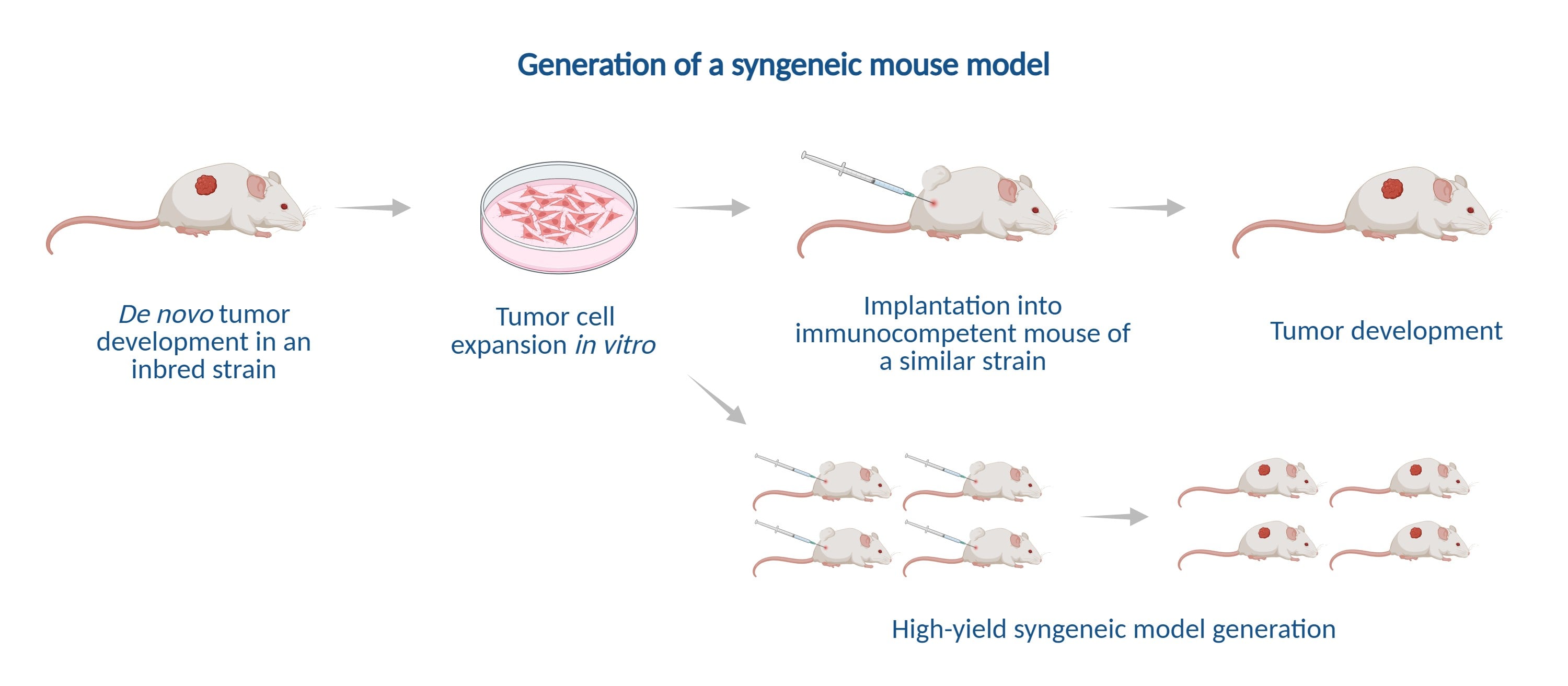
Generation of syngeneic tumor models. Tumor cells derived from an inbred mouse strain are expanded in vitro and implanted into genetically identical mice of the same strain, establishing immunocompetent tumor models. Rapid in vitro expansion and efficient engraftment enable high-throughput generation of syngeneic mice for large-scale studies. Created in BioRender. Estipona, D. (2025) https://BioRender.com/y3di75y
How to improve the predictive value of preclinical oncology studies
read more
Limitations of Syngeneic Models
A key limitation of syngeneic models is that they do not recapitulate the natural evolution of human tumors. Transplanted tumors often lack the genomic heterogeneity, cancer stem cell populations, and diverse tumor microenvironment (TME) characteristics of de novo tumors. Additionally, the rapid and uniform growth kinetics typical of these models create several challenges for immunotherapy evaluation. Fast tumor progression limits the time window for assessing treatments that require prolonged immune activation, makes it difficult to study early-stage therapeutic interventions, and prevents the development of the chronic inflammatory TME characteristic of human cancers. Finally, positive results with murine cell-based therapies, such as CAR-T cells, often do not repeat in human clinical trials due to species-specific differences. However, while not fully recapitulating human tumor biology, syngeneic models offer a cost-effective and tractable early stage in vivo platform that can strategically complement more translational systems such as patient-derived xenografts, organoid cultures, and humanized mouse models.