Xenograft models are ideal for studying human tumors in an in vivo context, but they often cannot fully replicate the stepwise progression of spontaneous tumor development within an intact immune system. Genetically engineered mouse models (GEMMs) address this gap by harboring defined oncogenic mutations that drive de novo tumorigenesis in immunocompetent hosts. These sophisticated platforms enable investigation of cancer initiation, progression, and therapeutic response in contexts that closely mirror human disease biology.
Sponsored by:

In this 15-minute webinar, Dr. Rajendra Kumari provides a guide on what to consider when choosing animal models of oncology and immuno-oncology.
read more
What are GEMMs?
Genetically engineered mouse models (GEMMs) are transgenic mice with defined mutations designed to mimic oncogenic activations and/or tumor-suppressor losses observed in specific human cancers. Tumors arising de novo in these models closely mirror human disease at histopathological, molecular, and clinical levels, including the composition of the tumor microenvironment. GEMMs have advanced from single-allele constructs to sophisticated multiallelic designs that better parallel human genomic complexity. GEMMs have found wide use in clinically oriented studies, such as in validating drug targets, assessing the efficacy of targeted agents and chemotherapies, and studying mechanisms of drug resistance, with therapeutic responses often aligning with those seen in patients. GEMMs also operate in the context of a functional immune system and are well-suited for preclinical evaluation of cancer immunotherapies. When integrated with matched human studies, these robust and predictive in vivo platforms support the development of novel cancer therapies and strategies.
Types of GEMMs
GEMMs are engineered using three common strategies: knock-in, knock-out, and conditional or inducible variants. Knock-in, or a gain-of-function approach, inserts a transgene or modified allele, often to activate oncogenic pathways. This method often utilizes fluorescent or bioluminescent cassettes such as GFP or luciferase to quantify promoter activity, trace lineages, and monitor tumor kinetics longitudinally. Knock-out, or loss-of-function, modifications disrupt a defined gene or DNA segment to reveal tumor suppressor requirements for cancer initiation, progression, or therapeutic response. Conditional and inducible knock-outs use recombinase sites flanking key exons to inactivate genes in selected tissues or cell types using specific promoters. They can also allow temporal control by switch alleles on or off at specific disease stages using transactivator compounds such as tamoxifen or doxycycline.
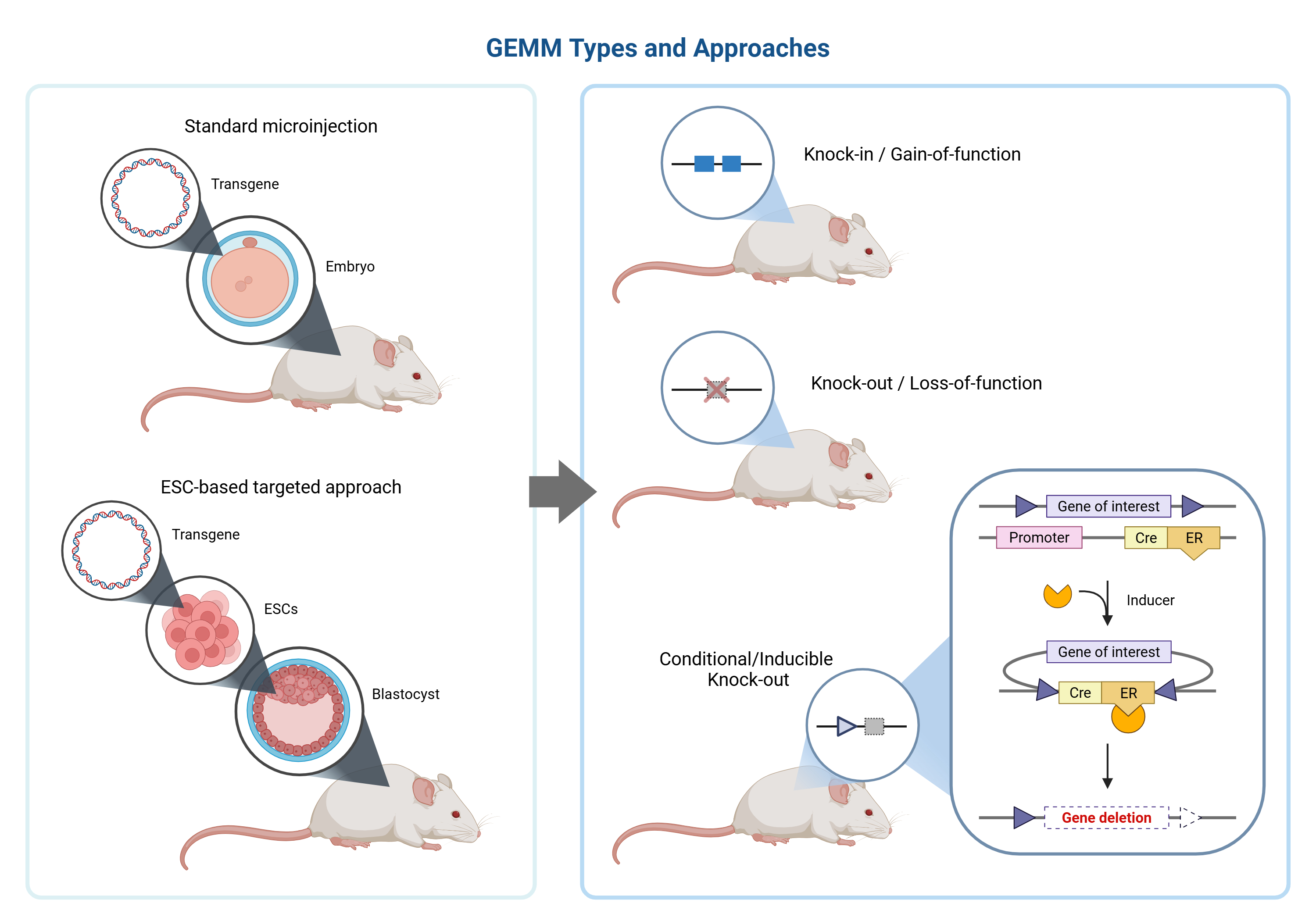
Generation of genetically engineered mouse models (GEMMs). Genetic modifications are introduced through pronuclear microinjection or targeted editing of embryonic stem cells (ESCs) followed by blastocyst implantation. These approaches generate three main GEMM types: knock-in, knockout, and conditional/inducible models. Conditional systems typically use Cre-loxP recombination activated by specific inducers. Created in BioRender. Estipona, D. (2025) https://BioRender.com/lz93o3v
Designing GEMMs
Transgenes in GEMMs are established either by standard microinjection into the pronucleus of fertilized mouse embryos or by gene targeting in embryonic stem cells (ESCs) and insertion into blastocysts. Pronuclear injection yields random integration with variable copy number and position effects, while ESC targeting via homologous recombination enables precise knock-in or knock-out alleles that can be combined with Cre-lox strategies for conditional control. Additional approaches include somatic cell nuclear transfer, retroviral-mediated transgenesis, sperm- or testis-mediated gene transfer, RNAi-based knockdown, and programmable nuclease platforms, like ZFNs, TALENs, and CRISPR-Cas9. Each method carries trade-offs in precision, efficiency, mosaicism, off-target risk, and ease of scaling, so the choice depends on experimental goals and required allele architecture.
Rapidly review, compare, and select models from our diverse multi-model oncology portfolio.
read more
Access to GEMMs
A significant bottleneck in GEMM-based preclinical research is time, since engineering, breeding, and validating new lines can take many months before cohorts are study ready. To accelerate programs without compromising biological fidelity, researchers can source pre-established strains and study support from strain repositories, databases, and commercial providers. Public options include the NIH National Cancer Institute Mouse Repository, the Mutant Mouse Resource and Research Centers, the European Mouse Mutant Archive, and the International Mouse Strain Resource, which streamlines discovery of available alleles and distribution sites. Commercial platforms such as The Jackson Laboratory, Charles River, Crown Bioscience, and Taconic Biosciences provide access to a diverse GEMM catalogs with additional support to enable target validation, efficacy, and resistance studies on clinically relevant timelines.