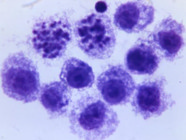
Jurkat cells are immortalized T lymphocytes first derived from the peripheral blood of a young leukemia patient. Originally called JM cells, Jurkat cells found their significance due to their robust ability to produce interleukin-2. The line has since become central in studies to elucidate T-cell receptor signaling and T-cell activation. Jurkat and its variants are now used in many research areas, such as in protein expression, viral interactions, and cancer biochemistry, among others. A genome-wide survey has identified mutations in several genes, including PTEN, INPP5D, CTLA4, SYK, TP53, BAX, MSH2, and C1GALT1C1. These should be considered when designing experiments and analyzing data using Jurkat cells. Visit the cell supplier page for more information.
Your search returned 2 Jurkat Cell Lines across 1 supplier.
Select up to 5 products from below to compare or request more information.
- Jurkat cells, which originated from the peripheral blood of a 14-year-old with T-cell acute ...
- T-cell biology research, development of T-cell therapies, ...
- one cryovial
Read More
- Jurkat E6.1 cells, a derivative clone of the Jurkat cell line, which originates from the peripheral ...
- Inquire
- one cryovial
Select up to 5 products from above to compare or request more information.
Tags:
Please Login or Register to Create Tags