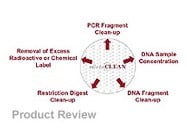
When working with PCR-based techniques, every scientist’s main concern is DNA sample purity. Most of the currently used purification kits are based on selective binding to membranes, either in tubes or in multi-well plate formats. The Microclean System uses instead a single reagent that can be added straightaway to DNA samples in standard PCR tubes. It is capable of cleaning up or concentrating any type of double stranded DNA of at least 50bp, efficiently removing reaction buffers, enzymes, primers, primer dimers and dNTPs.
Microclean buffer is the sole component of the kit. It has to be added in a 1:1 volume ratio to each DNA sample. It can be added directly into the PCR reaction tube or into a separate tube, where the sample has been previously transferred. I prefer this second choice since it is easier to successively remove supernatant from a wider tube. After reagent addition, the solution has to be mixed thoroughly and spun briefly. This is a very important step, because the Microclean buffer is quite dense and only an accurate mixing assures that every DNA molecule is in contact with the purification reagent. A brief 5 minute rest at room temperature allows completion of the binding reaction and is followed by a 5 minute spin at high speed in a microfuge. The supernatant must be removed completely and carefully, without disturbing the invisible DNA pellet. Residual Microclean must be removed after a brief spin. This is another very important step, as residual buffer can interfere with downstream reactions. The pellet is finally resuspended in deionized water or TE buffer and allowed to rest for 5-10 minutes at room temperature, allowing the DNA to rehydrate completely. Samples can then be stored or undergo further reactions.
The whole procedure is fast and simple, yet results are optimal. I performed some purification tests before choosing this system for my lab and the outcomes were comparable to those obtained with other kits I was using at that time. These kits were more expensive and required much more work. I have been using Microclean for more than one year now and I think it is a reliable and very efficient system. I never had problems with regard to DNA purification nor inhibition of downstream reactions related to Microclean interference. I have actually used faster systems but all of them were made up of many different buffers and components. What I like most about Microclean is that it is a single-reagent kit: you cannot use the wrong buffer by mistake or exchange tubes between samples. It’s a fault-free system, and although the mixing step is relatively time-consuming I still prefer Microzone’s kit to other faster and more complicated systems.
I find the Microclean kit handy and straightforward, especially when working with many samples at a time, even if it is not one of the quickest systems available. Moreover it is very inexpensive, costing much less than competitor kits. Overall, Microclean is an excellent system, providing reliable results with high efficiency for every kind of sample.
Dr. Andrea Galli
University of Milan
Dept of Clinical Sciences