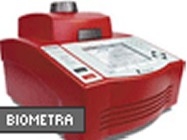
One of the major reasons I purchased the Tpersonal thermal cycler was because it was favorable in terms of efficiency and cost. Three different versions of this cycler are available depending on the block capacity needed: 48-well version, 20-well version and a combi-block version. I have the 48-well version in my laboratory and I believe that the features it offers are equally applicable to the other two versions as well.
The 48-well version, as the name suggests, can take up to 48 0.2 ml reaction tubes. The 20-well version is probably used for larger reaction volumes as it can take 20 tubes of 0.5 ml each. The instrument is extremely compact and very light (approximately 7 kg). Additionally, as the instrument is inexpensive; I believe that it outperforms several other thermal cyclers available in the market.
Biometra claims that this is the first thermal cycler with a ‘smart lid’ technology. The heated lid is oil-free and is designed to apply ‘optimal’ pressure to the sample tubes such that heat transfer during PCR is efficiently carried out. I program the lid to provide temperatures between 99 and 105ºC; however, the temperature can reach upto 110ºC. Both heating and cooling rates of this instrument are about 3ºC/s and the instrument can cool samples to less than 4ºC. I sometimes use this option to slowly cool some of my samples before setting up other experiments with them (this is not essentially related to a PCR reaction!). The heating and cooling are achieved using Peltier technology. The Peltier can reach temperatures of -1ºC, although I do not find any use for this feature in my PCR reactions.
I find that programming the instrument is easy, and I do it in one step, with the aid of a very good display containing all the options required for a PCR cycle. I can also store different reaction cycles and use them when I run similar reactions. I have stored upto 35 different programs to date, and the instrument offers the feature of storing a total of 1000 programs in a total of 10 directories! I believe that this feature would be helpful in multi-user environments, wherein different sets of programs can be stored by several users in their respective directories, without the need to overwrite another’s program.
There are several other features in the software that I find very useful. I can pause the reaction at any time and resume it later. Additionally, in the case of a power failure, the instrument can resume the reaction from the last time point. I can also set the thermal cycler to activate an alarm when the reaction is over. In addition, I can link up the cycler to a printer via a serial port, and I can print out the different programs for future reference.
Overall, I believe that this thermal cycler is very useful for those who are on the lookout for a quiet, compact, cost-effective instrument that provides quick PCR reactions with low power consumption.