Visualization of proteins on a gel can present a challenge as there is no universal reagent (like ethidium bromide) available for staining. There are a variety of protein stains available, each with their own pros and cons. Some of the most common products used are silver, coomassie and various kinds of fluorescence stains (such as Sypro Ruby Red). It is important to research the strengths and weaknesses associated with each product to determine which is appropriate for your application.
Silver staining is the most sensitive procedure for visualizing proteins, but is limited in terms of the small dynamic range (about one log). For projects that require a larger dynamic range, coomassie or fluorescent stains would be more suitable (2 and 3 log range, respectively). Additional problems associated with the use of silver stain include waste removal and incompatibility with downstream applications, such as mass spectroscopy.
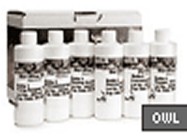
For research that is compatible with the use of silver stain, we have found the Owl product to be an effective silver stain kit. The robust procedure of this kit has proven useful, as we have used this product for diverse protocols such as checking protein purity and high-end proteomics. The kit will remain a staple in our lab, even though newer kits have been used with more regularity. Our lab has used this kit for a variety of applications, including SDS Page and two dimensional gel electrophoresis. The results were typical of other silver stain kits with sensitivity in the nanogram range.
The required reagents for performing the protocol are all present in the kit (except very low conducting water, methanol and acetic acid) and the procedure is quick and easy. When comparing this product to its competition, it clearly stands out as one of the best kits available. Although two clear drawbacks are the lack of compatibility for down steam applications such as mass spec, and the length of time associated with the procedure. Unfortunately, it often seems to be overshadowed by the huge array of other products available for silver staining. Overall, this is a good kit to have for labs that only perform proteomic analysis occasionally. Other labs may find this kit lacking when comparing it to the newer competition due to its two drawbacks mentioned above.
Jeff Perry
Lab Manager
University of Michigan, Medical School