Depending upon the differentiation capacity, stem cells may be pluripotent, multipotent or unipotent. Pluripotent cells are capable of differentiating into different organs while multipotent cells are those that can differentiate into various tissues depending on the conditions they are exposed to. Unipotent cells have a lineage that is already defined and they can only differentiate into specific cell types. Due to their great potential for tissue regeneration and disease treatment, stem cell research has gained a lot of attention over the past decade. Identification of specific markers defining neural and hematopoietic stem cells has led to the development of products to isolate distinct stem cell populations.
Neural cell adhesion molecule (NCAM) is a trans-membrane molecule expressed in embryonic and neonatal neural tissue. PSA-NCAM is a highly polysialated form of NCAM that is specific to stem cells with high neurogenic potential. PSA-NCAM is generally accepted as a marker for neuronal committed progenitor cells. These cells are shown to be capable of differentiating in to GABAergic and dopaminergic interneurons. Several studies have used expression of PSA-NCAM to isolate immature neuron committed progenitor cells.
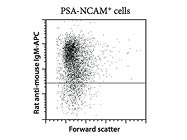
Miltenyi Biotec have developed the PSA-NCAM MicroBead Kit for positive isolation of PSA-NCAM expressing cells from a variety of tissues and cell populations, including postnatal mouse and rat forebrain, mouse SVZ tissue and fetal human brain tissue. The kit contains magnetic microbeads labeled with anti-PSA-NCAM antibodies and an FcR blocking agent to block non-specific binding. The protocol for isolation is simple and is not time consuming. The cells are first magnetically labeled with PSA-NCAM microbeads by incubating the cells with the blocking agent for 10 min at 4°C and for 15 min at 4°C with the microbeads. After a few washes, the PSA-NCAM cells are subsequently separated by passing the cell suspension through a column placed in the magnetic field of a MACS cell separator. Once the unlabelled PSA-NCAM negative cells flow through, the column is removed from the magnetic field and the PSA-NCAM+ cells are flushed out. An additional advantage of using this method of isolation is that cells that express other markers such as CD133 or A2B5 can first be isolated and therefore, a number of progenitor cells expressing different markers can be isolated from a single tissue.
The PSA-NCAM MicroBead Kit has been used in our laboratory for the past year for isolation of neural stem cells from fetal human brains on several occasions. The attractive feature of this kit is the relative ease with which a reasonably pure population of PSA-NCAM expressing cells can be isolated from a heterogeneous cell suspension. Despite the trauma of flushing out the PSA-NCAM+ cells, cell viability is not compromised. The kit does have certain limitations. To use this kit effectively, it is necessary to purchase magnetic cell separators MiniMACS, MidiMACS or SuperMACS and positive selections columns, both of which are supplied by Miltenyi Biotec. The company also offers a PE conjugated PSA-NCAM antibody for flow cytometric or fluorescence microscopic verification of the isolated cells.
In summary, the PSA-NCAM MicroBead Kit from Miltenyi Biotec is an excellent tool for isolation of PSA-NCAM expressing progenitor cells from rodent and human tissues.
Scientist
Children’s Research Center of Michigan
Children’s Hospital of Michigan