Newly discovered multi-tasking taste cells that are capable of detecting sour, sweet, bitter, and umami stimuli are described in a PLOS Genetics paper published today.
To better understand how taste cells detect and signal the presence of different tastes, University of Buffalo researchers used an engineered mouse model to investigate the signaling pathways that the animals use to relay taste information to the brain. In the process, they discovered a previously unknown subset of Type III cells that were "broadly responsive" and could announce sour stimuli using one signaling pathway, and sweet, bitter and umami stimuli using another. (Taste buds employ three types of taste cells: Type I cells acts as support cells; Type II cells detect bitter, sweet and umami tastes; and Type III cells detect sour and salty flavors.)
Search Antibodies Search Now Use our Antibody Search Tool to find the right antibody for your research. Filter
by Type, Application, Reactivity, Host, Clonality, Conjugate/Tag, and Isotype.
The idea that mammals might possess broadly responsive taste cells has been put forth by multiple lab groups, but previously no one had isolated and identified these cells. The researchers suspect that broadly responsive cells make a significant contribution to our ability to taste. Their discovery provides new insight into how taste information is sent to the brain for processing, and suggests that taste buds are far more complex than we currently appreciate.
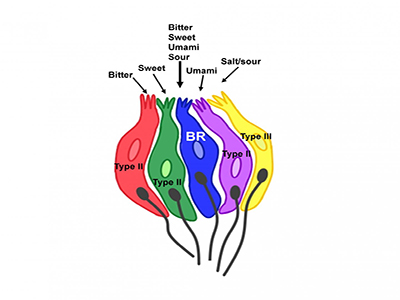
"Taste cells can be either selective or generally responsive to stimuli which is similar to the cells in the brain that process taste information," commented senior author Kathryn Medler. "Future experiments will be focused on understanding how broadly responsive taste cells contribute to taste coding."
Image: Most taste cells selectively respond to a specific stimulus type while broadly responsive cells respond to multiple taste qualities. Image courtesy of Jhanna Flora and Kathryn Medler.