Glial cells are vital for the proper formation, maintenance, and repair of synapses throughout the nervous system. But despite this, we’ve still had difficulties distinguishing specific glial cells at synapses from the diverse overall population of glial cells. This has been a major challenge in promoting and restoring the normal function of the nervous system following injuries, diseases, and aging. In a study published yesterday in eLife, Brown University researchers identified important molecules to study and to manipulate the specific glial cells integral to synapses.
“This discovery will serve as a springboard to addressing fundamental questions and developing assays to speed the discovery of therapeutics intended to preserve and restore the normal function of neuronal circuits,” says senior author Gregorio Valdez.
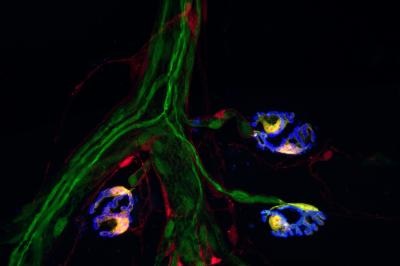
The study reveals that an important subtype of glia at neuromuscular synapses known as Schwann cells are the only cells in muscles expressing two specific molecules. These molecular markers provide a highly specific glial ‘bar code’ that identifies the vital cell subtype.
Search Antibodies Search Now Use our Antibody Search Tool to find the right antibody for your research. Filter
by Type, Application, Reactivity, Host, Clonality, Conjugate/Tag, and Isotype.
“What this means is that we can finally figure out how all three cellular constituents of the synapse—neurons, muscle, and glia—talk to each other,” Valdez says. “We now have a unique and important tool for identifying this critical component of the synapse. This is essential for knowing when and where to target to ensure synapses function appropriately.”
Valdez says the novel bar code tool will pave the way for future studies into neuromuscular disease such as amyotrophic lateral sclerosis (ALS) and spinal muscular atrophy (SMA). Scientists can use the molecular markers to probe the role of synaptic glia in neuromuscular synapse repair following injury, age-related degeneration, and neuromuscular diseases progression. He also anticipates that a similar approach will reveal the synaptic glial cells located at synapses between pairs of neurons in the brain.
“While our primary focus was the neuromuscular synapse, we also gathered initial evidence indicating that synaptic glia cells in the brain can be labeled and targeted using the same approach,” he says. “If true, this discovery could be of immense consequence for treating a myriad of brain conditions, including those involving cognitive decline due to normal aging and Alzheimer’s Disease.”
Image: Two molecular markers, indicated by the red and green fluorescence, are found together only in synaptic Schwann cells. Together they offer a 'bar code' that identifies Schwann cells, an important subtype of glia. Image courtesy of Valdez Lab / Center for Translational Neuroscience / Brown University.