In a new study that was published Friday in Science Advances, IRB Barcelona researchers identified a key factor in the development of luminal breast cancer. Characterized by the expression of estrogen receptors, luminal tumors are the most common subtype of breast cancer.
“Traditionally, much attention has been devoted to the in-depth study of how hormones regulate the development of the mammary gland at the transcriptional level, that is, the synthesis of messenger RNA from DNA,” says senior author Raúl Méndez. “In previous work by our group, we had discovered that factors called CPEBs regulate the next step, namely the translation of that messenger RNA into protein. This process is crucial for embryo development, and it is deregulated during the development in tumors other than those in the breast, such as those of the pancreas.”
The researchers discovered that CPEB2 is essential for protein synthesis after hormonal stimulation, a process that regulates both the proper development of the mammary gland and the formation of luminal breast tumors.
Search Antibodies Search Now Use our Antibody Search Tool to find the right antibody for your research. Filter
by Type, Application, Reactivity, Host, Clonality, Conjugate/Tag, and Isotype.
For the present study, the researchers generated new mouse models in which each of the four members of the CPEB family was inactivated. These models allowed the researchers to reveal CPEB2 as a key player in the estrogen signaling pathway. Without this factor, the most important mediators activated through the estrogen receptor are not synthesized, and, therefore, the response to hormone receptors decreases.
“The study allows us to affirm that cells proliferate less in the absence of CPEB2,” says first author Rosa Pascual. “We have seen in vivo that mice genetically engineered not to express CPEB2 are protected against luminal breast cancer.”
The research also reveals, using human data, that luminal breast cancer patients with low expression of CPEB2 have a better prognosis. Thus, a CPEB2 inhibitor could potentially be a good therapeutic candidate.
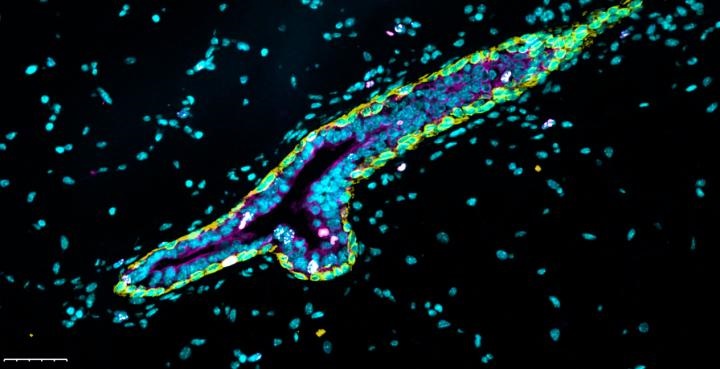
Image: This is a mouse mammary gland duct. Image courtesy of IRB Barcelona.