When do cells decide to divide? The textbook answer is that this decision occurs in the first phase of a cell’s existence—right after a mother cell divides into daughter cells. But research published yesterday in Science suggests that it’s actually the mother cell that determines if its daughter cells will divide.
In their experiments, the researchers found that rather than daughter cells deciding on their own whether to divide, they committed to another cell cycle or not immediately after division of the mother cell. This implies that the decision was made in the previous cell cycle, because the daughter cells were born already on one path or another.
“That got us thinking that maybe all the sensing of the environment is actually happening in the mother cell cycle,” says senior author Sabrina Spencer of CU Boulder.
Proliferation is driven in part by the availability of growth factors in a cell’s environment. In previous experiments, the researchers had to first remove all growth factors in order to synchronize the cells’ cycling, which perturbs cell cycle behavior. But this new research used time-lapse microscopy and cell-tracking technologies, allowing the scientists to film cells doing their own thing on their own time.
Search Antibodies Search Now Use our Antibody Search Tool to find the right antibody for your research. Filter
by Type, Application, Reactivity, Host, Clonality, Conjugate/Tag, and Isotype.
“Doing the experiment this way led to very different results,” Spencer says.
Their next question was, when in the mother cell cycle does a cell decide if its daughter cells will divide?
To answer this, the researchers removed and replaced the growth factors—which give the signal for the cell to divide—for several hours at different phases in the mother cell cycle.
They found that the longer these growth factors were removed in the mother cell, the less likely the daughter cells were to divide. If the growth factors were removed for more than nine hours, none of the daughter cells ended up dividing.
“We found that no matter when you blocked this signaling, cells can sense it,” says first author Mingwei Min. “And not only can they sense it, they can remember that information for many hours, all the way through to the daughter cell cycle.”
If cells are continually sensing growth factor signaling (as this study found) instead of only in the first phase of the daughter cycle, cancer drugs may have a longer window than previously believed to provide therapeutic effects.
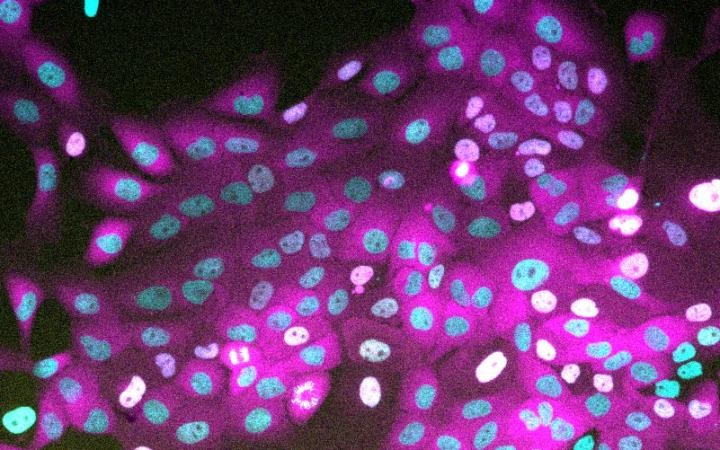
Image: Cells expressing a nuclear marker (H2B) in cyan, a cell-cycle protein (Cyclin D1) in yellow, and a proliferation marker (CDK2 activity sensor) in magenta. Image courtesy of Mingwei Min.