Intestinal parasites are a serious threat to both humans and livestock in large parts of Africa, South America, and Asia. A parasite’s larvae may infect humans and other organisms through contaminated food or by penetrating bare skin. Once the parasites mature inside the body, the host’s immune system has a hard time getting rid of them. However, scientists have had a hard time studying immune cells in infected tissues.
In a study published today in eLife, Malaghan Institute of Medical Research scientists present a new technique that may help scientists study the body’s immune response to intestinal parasite infections one gut cell at a time. The findings may help scientists to understand how adult parasites evade the immune system and to test ways to boost the immune response to fight these infections.
“One big problem has been the difficulty to extract immune cells from an infected gut, as the infection causes very strong local reactions such as intense cellular slime production to try and flush the worms out,” says senior author Johannes Mayer.
Search Antibodies Search Now Use our Antibody Search Tool to find the right antibody for your research. Filter
by Type, Application, Reactivity, Host, Clonality, Conjugate/Tag, and Isotype.
The scientists tested many different ways to extract immune cells from the guts of mice infected with a specific intestinal parasite, eventually developing a technique that isolated millions of immune cells from the infected animals’ guts. The technique involves a series of EDTA washes followed by soaking in an enzyme solution and then cell filtration.
“This allowed us to study the individual immune cells for the first time,” explains first author Laura Ferrer-Font. “We used a new technology called spectral flow cytometry to look at many different types of immune cells all at the same time and identified various changes that take place throughout the course of parasitic infection.”
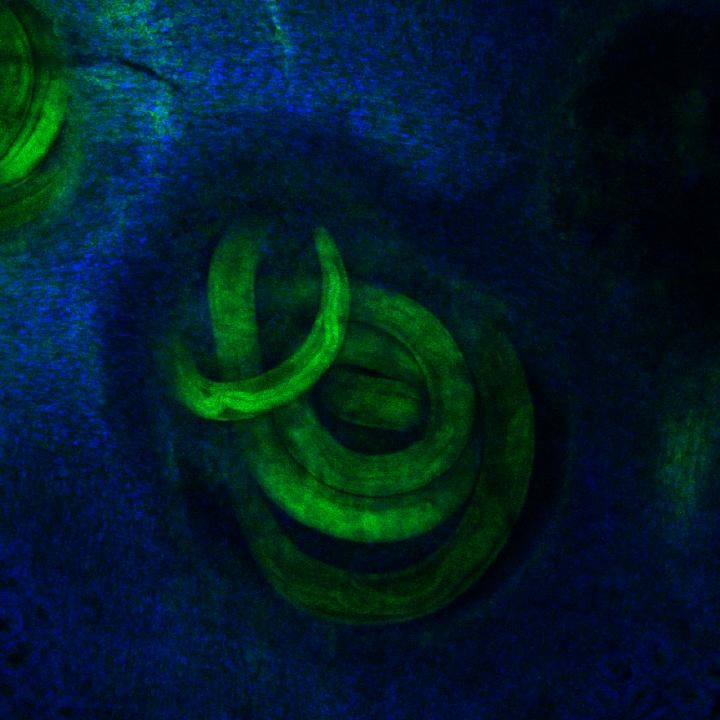
The team also verified that the immune changes they saw in the cells were representative of the immune changes that occurred in the tissue taken from the infected animals, ensuring that the cell-extraction process did not skew their findings.
“Now that we have found a way to extract immune cells from parasite-infected guts, we can start to answer important questions about the immune response,” Mayer concludes. “This technique will enable scientists to use powerful tools like single-cell RNA sequencing to study the immune response in different hosts. It might also help those studying inflammatory bowel disorders or food allergies to extract single cells from the gut for further investigation.”
Image: Larvae from the parasite Heligmosomoides polygyrus bakeri, shown here in green, develop within the intestinal tissue, with cells shown in blue. Image courtesy of Ferrer-Font et al. (CC BY 4.0).