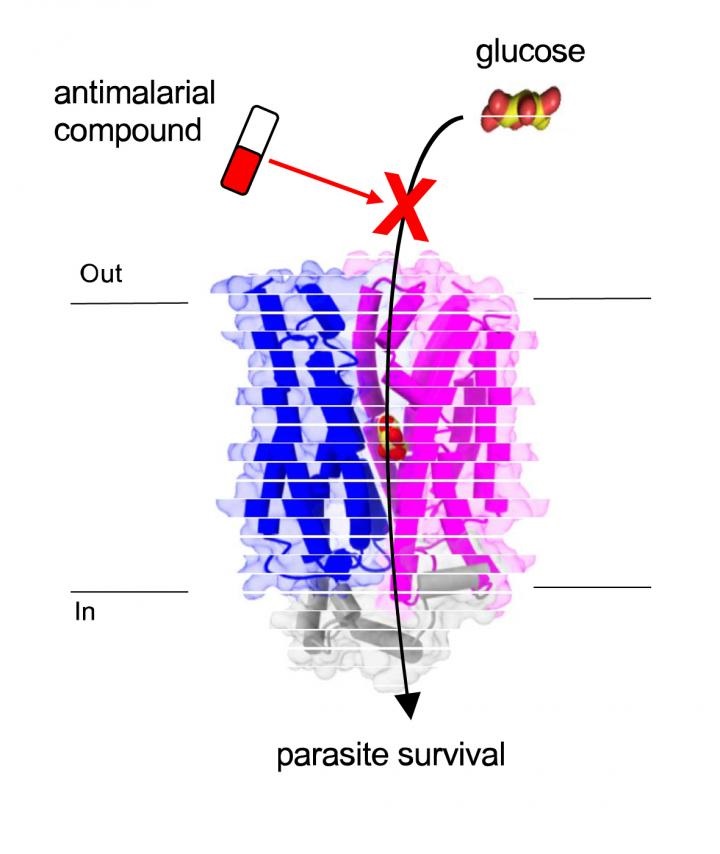
Sugar is a fundamental source of fuel in most living organisms. In the malaria parasite Plasmodium falciparum, the uptake of glucose is essential to its life cycle. Like in other cells, sugar is transported into the parasite by a transport protein—a “door” designed for sugar to pass through the cell membrane. In a study published today in Nature, the details as to how this “door” works have been revealed.
“By elucidating the atomic structure of the sugar-transporting-protein PfHT1, we can better understand how glucose is transported into the parasite,” says senior author David Drew of Stockholm University.
The main goal of the research is basic understanding of this important biological process, but with the potential for development of new antimalarial drugs. Malaria kills almost half a million people each year, according to the WHO. By blocking the door for sugar, it has been shown that one can stop the growth of the malaria parasites.
Search Antibodies Search Now Use our Antibody Search Tool to find the right antibody for your research. Filter
by Type, Application, Reactivity, Host, Clonality, Conjugate/Tag, and Isotype.
“It’s a long process from a compound with antimalarial activity to a drug that can be taken in the clinic,” Drew explains. “However, with this knowledge, one can improve known antimalarial compounds so that they are more specific to the malarial transporter, so they do not have the side-effect of stopping sugar transport into our own cells. As such, this knowledge increases the likelihood that more specific compounds can be developed into a successful drug.”
Surprisingly, the way that glucose is captured by the sugar-transporting protein in malaria parasites is similar to the way that glucose is captured by transporters in the human brain, despite the millions of years of evolution between parasites and humans.
“This conservation reflects the fundamental importance of sugar uptake—basically, nature hit on a winning concept and stuck with it,” Drew says.
However, the malaria parasite is more flexible. Other sugars, such as fructose, can also be imported. This flexibility could give a selective advantage to the malaria parasite so that it can survive under conditions in which its preferred energy source, glucose, is unavailable.
“Every biochemistry student is taught about the process of sugar transport and it is exciting to add another important piece to this puzzle,” says coauthor Lucie Delemotte, also of Stockholm University.
Image: Structure of the transport protein PfHT1 in complex with the sugar D-glucose. Image courtesy of David Drew.