A gene called Elongation of Very Long Chain Fatty Acids Protein 2 (ELOVL2) is an established biomarker of age. In a paper published yesterday in Aging Cell, UCSD researchers wrote that the gene appears to play a key role in age-associated functional and anatomical aging in vivo in mouse retinas, a finding that has direct relevance to age-related eye diseases.
The researchers found that an age-related decrease in ELOVL2 gene expression was associated with increased DNA methylation of its promoter. But when researchers reversed the hypermethylation in vivo, they boosted ELOVL2 expression and rescued age-related decline in visual function in mice.
“These findings indicate that ELOVL2 actively regulates aging in mouse retina, provides a molecular link between polyunsaturated fatty acids elongation and visual functions, and suggests novel therapeutic strategies for treatment of age-related eye diseases,” wrote the authors.
ELOVL2 is involved in production of long-chain omega-3 and omega-6 polyunsaturated fatty acids, which are used in several crucial biological functions, such as energy production, inflammation response, and maintenance of cell membrane integrity. The gene is found in humans as well as mice.
Search Antibodies Search Now Use our Antibody Search Tool to find the right antibody for your research. Filter
by Type, Application, Reactivity, Host, Clonality, Conjugate/Tag, and Isotype.
In particular, ELOVL2 regulates levels of docosahexaenoic acid (DHA), a polyunsaturated omega-3 fatty acid abundantly found in the brain and retina. DHA is associated with a number of beneficial effects. Notably, its presence in photoreceptors in eyes promotes healthy retinal function, protects against damage from bright light or oxidative stress, and seems to improve a variety of vision conditions such as age-related macular degeneration, diabetic eye disease, and dry eyes.
Senior author Dorota Skowronska-Krawczyk says that the work demonstrates for the first time that a “methylation clock” gene has a functional role in the aging of an organ—in this case, the eye. DNA methylation is used throughout the human body, essentially turning biological switches on and off to maximize efficient operation. It has key regulatory roles in the body’s cardiovascular, neurological, reproductive, and detoxification systems.
In recent years, there has been much work and progress in identifying possible biomarkers that predict the biological age of individuals. Such biomarkers would be useful in identifying risk and status of age-related diseases. ELOVL2 is among the genes attracting greatest interest.
“I have been asked whether I think ELOVL2 is the aging gene,” says Skowronska-Krawczyk. “After thinking about it, it is not unreasonable to think that lower ELOVL2 expression might be at the basis for many age-related conditions. Future work in our lab will address that question.”
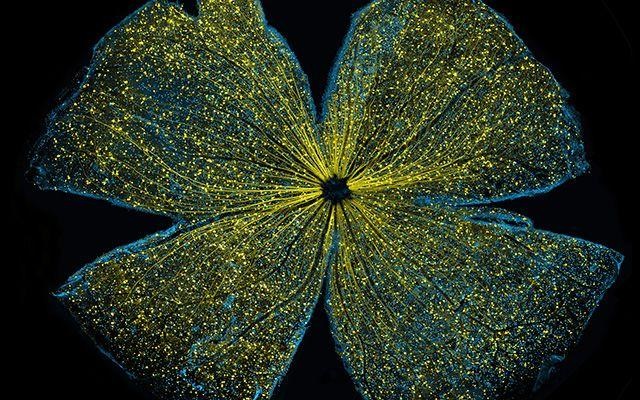
Image: This is a confocal microscope image of mouse retina sparkling with fluorescent molecules. Image courtesy of Keunyoung Kim, Wonkyu Ju and Mark Ellisman, all of the National Center for Microscopy and Imaging Research at UC San Diego.