Growing a model organ from a patient’s own cells may one day be possible, allowing physicians to better understand their patients’ diseases and to test which drugs are likely to help them. But this future relies on our ability to form complex tissues from stem cells—a challenging undertaking.
In their natural environment, stem cells form predictable patterns as they mature. Over time, these patterns morph into the tissues of an adult organism. However, in the lab, researchers have struggled to control the spatial organization of stem cells. “Despite the importance of organization for functioning tissues, we as scientists have had difficulty creating tissues in a dish with stem cells,” says co-first author Ashley Libby of UCSF. “Instead of an organized tissue, we often get a disorganized mix of different cell types.”
Now, in a study published today in Cell Systems, scientists have used a computational model to learn how to coax stem cells into forming new arrangements, including those that might eventually be useful in generating personalized organs.
Search Antibodies Search Now Use our Antibody Search Tool to find the right antibody for your research. Filter
by Type, Application, Reactivity, Host, Clonality, Conjugate/Tag, and Isotype.
The team previously showed that knocking down the expression of two different genes, ROCK1 and CDH1, affected the layout of iPS cells grown in a Petri dish. They wondered whether they could predict the exact arrangement of cells that would result from altering ROCK1 and CDH1 by different degrees at different timepoints. But there were so many possible variables—the timing and degree of each gene knockdown, the duration of the experiment, the proportion of cells affected—that testing every possible combination would be too time-consuming. So the team created a model to do the job.
The machine-learning program used results from the initial stem cell experiments to infer ways that ROCK1 and CDH1 affect iPS cell organization. With the model up and running, the researchers then began to probe whether it could compute how to make entirely new patterns, like a bull’s eye or an island of cells.
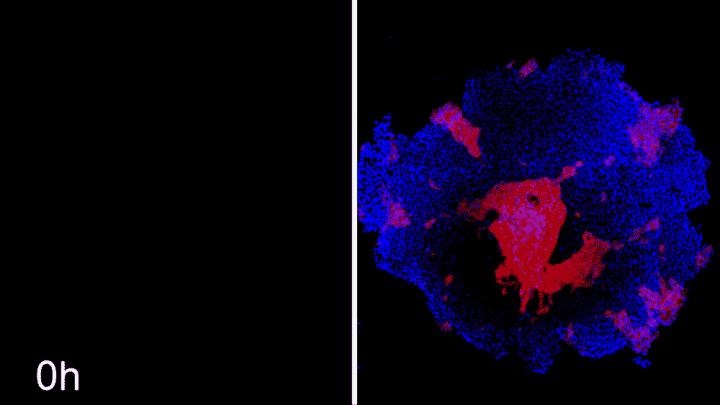
The simulations narrowed down a set of starting conditions that might lead to the desired arrangement of cells—informing researchers exactly when, where, and how to add drugs to their iPS cells to shut off ROCK1 and CHD1. Then, the team could test those suggested conditions. The machine-learning system, it turned out, was correct—at least when it came to the bull’s eye and island patterns they were after.
Image: Machine learning predicts conditions that will cause stem cell colonies to form desired patterns. (Left) Video showing simulated interactions between different stem cell populations. (Right) Stem cells grown in conditions dictated by the machine-learning program generate a colony that forms a bull's-eye pattern, as predicted. Image courtesy of Ashley Libby, David Joy, and Iman Haghighi, Gladstone Institutes.