Researchers at the Salk Institute and the University of Texas Southwestern Medical Center have created mouse blastocyst-like structures, or "blastoids," from a single cultured cell. As the team reported today in Cell, these cultured blastoids have the same structure as natural blastocysts and could help advance research into development as well as inform issues around pregnancy, infertility, or health problems later in the offspring's life.
"These studies will help us to better understand the very beginnings of life; how early on in life a single cell can give rise to millions of cells and how they are assembled in space and time to give rise to a fully developed organism. Importantly, this work avoids the use of natural embryos and is scalable," says senior author Juan Carlos Izpisua Belmonte.
Natural blastocysts, which can become an embryo once they implant in a uterus, have proven difficult to study. The problem is that animal models, such as mice, only produce these structures in small numbers, and scientists cannot easily test the effects of malnutrition or exposure to toxins or a variety of genetic mutations on development at a level sufficient for study.
Search Antibodies Search Now Use our Antibody Search Tool to find the right antibody for your research. Filter
by Type, Application, Reactivity, Host, Clonality, Conjugate/Tag, and Isotype.
The Salk and UT Southwestern teams developed the blastoids using extended pluripotent stem (EPS) cells. The cells were put into a chemical solution that prompted them to turn into induced pluripotent stem cells. To encourage the iPS cells to form blastoids, the researchers put them in small groups in a special culture medium where they soon formed connections with each other.
Over time, the connected cells started forming a ball with an inner and outer layer. The cells facing inward accumulated proteins that made them distinct from the outside cells. The cells facing outward also began activating a protein called YAP, which entered the cell nucleus and began the process of inducing expression of proteins to build what could eventually become a placenta.
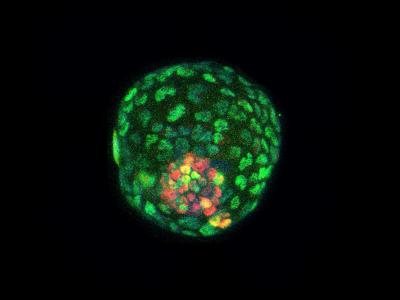
The blastoids contained the same three primordial cell types found in natural blastocysts. They were also a similar size as natural blastocysts and showed a similar gene signature. Further experiments indicated that the blastoids could further develop into structures resembling early post-implantation embryos.
Image: Blastocyst-like structures (blastoids) from cultured mouse cells immunofluorescently stained for the trophectoderm marker CDX2 (green) and the inner cell mass marker SOX2 (red). The trophoectoderm is the term for the outer cells of the blastoid. Image courtesy of Salk Institute/Waitt Advanced Biophotonics Core Facility