Activation of the mTor complex 1 in cells is central to many vital processes in the body such as cell growth and metabolism. Overactivity of this signaling pathway can result in diseases such as in diabetic insulin resistance and cancer. Now researchers have discovered how inactivation of a certain lipid kinase promotes mTor complex 1 activity, providing a new point of attack for the treatment of diabetes and cancer.
The signaling pathways in somatic cells are highly complex and specific mechanisms can only be triggered if several "switches" are "flipped" in a fixed sequence. However, given the high number of substances and substance complexes involved in the cellular signal transmission, finding these "switches" and identifying their role is a real challenge. The question of how mTor complex 1 can be deactivated has long been unclear.
Now, a team led by Leibniz-Forschungsinstitut für Molekulare Pharmakologie (FMP) researcher Alexander Wallroth has some insights on the process; their results were published yesterday in Nature Cell Biology.
Search Antibodies Search Now Use our Antibody Search Tool to find the right antibody for your research. Filter
by Type, Application, Reactivity, Host, Clonality, Conjugate/Tag, and Isotype.
"We manipulated the lipid kinase in various ways and looked at the effects these manipulations had on mTOR and activity on cell growth," Wallrot explains. As a result, they uncovered a mechanism for inactivating the PI3KC2ß lipid kinase. Another kinase that plays a key role here is protein kinase N (PKN), which renders the PI3KC2ß lipid kinase inactive, thereby indirectly activating mTOR in the process. Protein kinase N is regulated by growth factors that stimulate the mTor complex 2 at the cell membrane. This, in turn, activates PKN, which ultimately inactivates the lipid kinase.
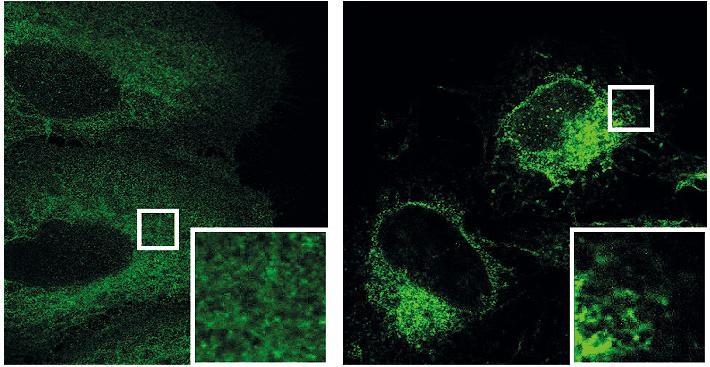
"In doing so, we revealed two further components prone to pharmacological attack", adds Wallroth. Successfully inhibiting PKN activates the lipid kinase PI3KC2ß and ends up inhibiting mTOR-dependent cell growth. Conversely, if the signaling pathway is activated by growth factors, mTOR complex 2, and, finally, PKN, the lipid kinase remains inactive and the mTOR complex 1 is able to drive cell growth. Although inhibitors capable of inhibiting PKN have already been identified, their lack of specificity and tendency to block many other vital cellular processes currently precludes their use in living tissue.
Image: Left: Protein kinase N (PKN) is active and inhibits PI3KC2ß (green). Right: PKN is missing. This causes PI3KC2ß to change the localization in the cell and to become active. Image courtesy of Alexander Wallroth, FMP.