The nascent polypeptide-associated complex (NAC) has been shown to act as a major protein identifying and, possibly, sorting device inside the cell. An international team of researchers reported today in Molecular Cell that NAC inserts the N-terminal domain of its β-subunit (N-βNAC) deep into the ribosomal tunnel to sense substrates directly upon synthesis and to escort growing polypeptides to the cytosol.
"No other factor we know does that, which is why we were so utterly surprised by our findings. Although NAC was discovered as long as 25 years ago, we are only now beginning to understand how crucial it is for proper cell function. Our study shows that, besides acting as a chaperone both on and off the ribosome, NAC is also able to recognize nascent polypeptide chains deep inside the ribosomal tunnel," says Professor Elke Deuerling, lead author. "We already knew NAC to transiently interact with translating ribosomes. But we did not understand how exactly NAC interacts with the ribosome and with nascent substrates to regulate protein folding and transport to the endoplasmic reticulum, which is essential for organismal viability."
The researchers performed biochemical, genetic, and structural analyses in C. elegans to attain a more detailed understanding of how NAC identifies and sorts nascent polypeptide chains inside the ribosomal tunnel. "Until quite recently, we assumed that the earliest point of interaction between ribosome-associated factors such as chaperones, enzymes, and transport proteins was when the nascent polypeptide chains exit the ribosomal tunnel," explains Dr. Martin Gamerdinger, first author on the study. "Usually, at that point, the chains have a length of about 40 amino acids. What we have discovered is that NAC binds to nascent chains as short as ten amino acids or even shorter, and it is doing it inside the tunnel. This makes NAC the very first factor to contact newly synthesized proteins. We even suspect it to be able to sense when the first two amino acids of a nascent protein connect with each other.”
Search Antibodies Search Now Use our Antibody Search Tool to find the right antibody for your research. Filter
by Type, Application, Reactivity, Host, Clonality, Conjugate/Tag, and Isotype.
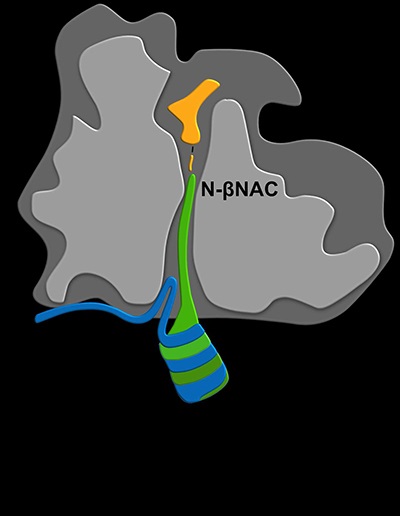 As the researchers have been able to show using a combination of cryo-electron microscopy, mass spectrometry, and biochemical analyses, including a series of site-specific crosslink experiments, NAC inserts the positively charged and highly flexible N-terminal domain of its β-subunit (N-βNAC) into the ribosomal tunnel, which is for the most part lined by negatively charged ribosomal RNA. "What our study demonstrates is that NAC is able to sense translation activity inside the tunnel and, more importantly, that it is able to sense the character of the proteins that are being synthesized. At least that is our current hypothesis," adds Deuerling.
Image: Ribosome binding of NAC is mediated by a ribosome binding regulatory arm (N-αNAC, blue) and a translation sensor domain (N-βNAC, green). N-βNAC senses short nascent chains already deep inside the ribosomal tunnel close to the peptidyl-transferase centre (orange) where amino acids are assembled into proteins. The tunnel-sensing activity of NAC is believed to orchestrate general cotranslational protein folding and transport processes in the cell.