Ribosomes, the molecular machines that produce proteins in cells, need to regenerate once they finish a job. This process is important for protein quality and thus for cellular homeostasis. In a study published this week in Cell Reports, researchers watched one of the most important enzymes for ribosome recycling—ABCE1—at work.
“Ribosome recycling is governed by an extraordinarily complex and conserved machinery, which has medical significance as yet unimagined,” says senior author Robert Tampé of Goethe University Frankfurt.
Search Antibodies Search Now Use our Antibody Search Tool to find the right antibody for your research. Filter
by Type, Application, Reactivity, Host, Clonality, Conjugate/Tag, and Isotype.
The ABCE1 enzyme can split ATP, the energy currency of cells, and use the energy released to separate the two ribosomal subunits. “Recent structural and functional data have shown that a conformational change of the enzyme, that is, a change in its spatial structure, is essential within this process for the diverse functions of ABCE1,” says Cordes.
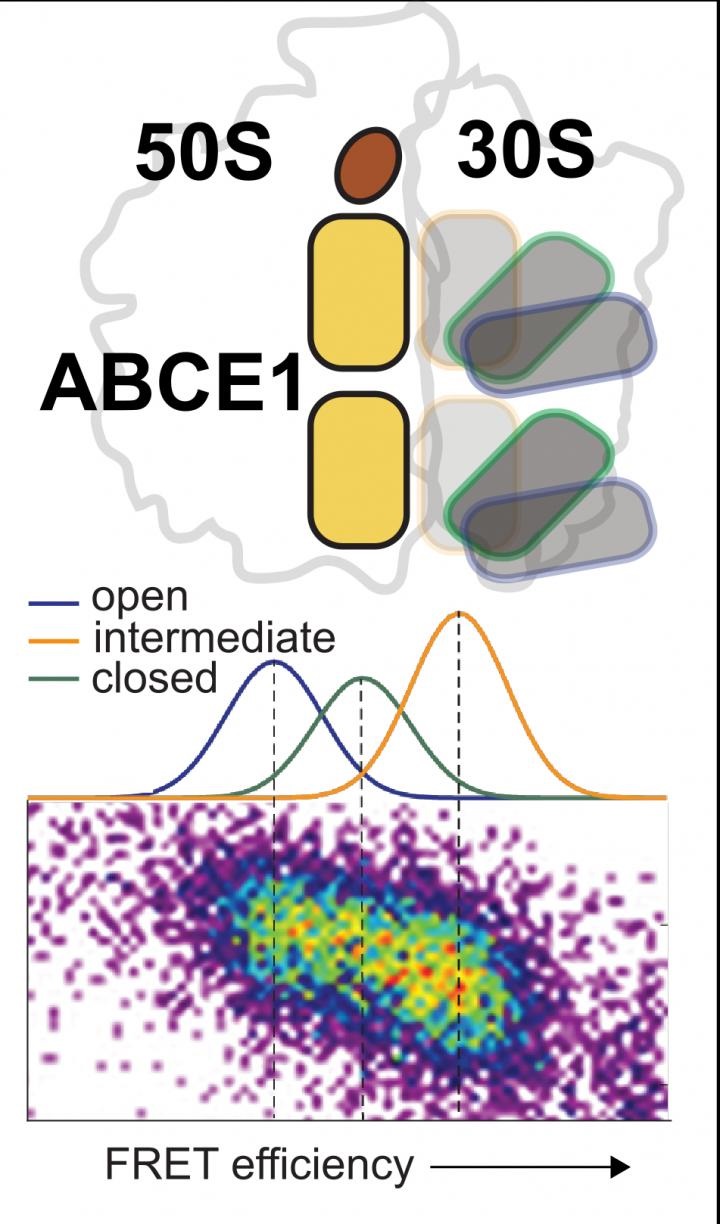
Using an integrated test approach, the team has now observed firsthand the structural variability of ABCE1 at the level of single molecules. They established that the two ATP binding sites of ABCE1 can adopt three conformations—open, intermediate, and closed—that are in a state of dynamic equilibrium. Interaction of ABCE1 with both the ribosome and the ATP influences the structural dynamics of the two ATP binding sites. This results in a complex network of different states, in which ribosome and ATP shift the equilibrium in the direction of the closed conformation.
“We assume that the conformations perform functionally different roles in the dissociation of the ribosome as well as for the many other diverse functions of ABCE1,” says coauthor Thorben Cordes of the University of Groningen.
Image: Three states of nucleotide-binding sites can be seen in the histogram: open, intermediate and closed. Image courtesy of T. Cordes, LMU Munich.