Some people have the ability to control HIV naturally—without treatment. In these very rare individuals, no multiplication of the virus in the blood can be detected after more than 10 years of infection. In 2007, scientists from the Institut Pasteur found that the CD8 cells in these “HIV controller” subjects are able to rapidly destroy infected CD4 cells. The new study, published today in Nature Metabolism, describes the characteristics of CD8 immune cells in these HIV controller subjects.
On the outside, the CD8 cells of both controllers and non-controllers appear to be identical. But the scientists demonstrated that they have a different molecular program. Anti-HIV CD8 cells in controllers have huge antiviral potential, and they are also programmed to survive—whereas in non-controllers, the cell program predisposes them to exhaustion and cell death. Working ex vivo, the scientists successfully reprogrammed cells from infected non-controller individuals to give them the same antiviral potency as the controllers’ cells.
Search Antibodies Search Now Use our Antibody Search Tool to find the right antibody for your research. Filter
by Type, Application, Reactivity, Host, Clonality, Conjugate/Tag, and Isotype.
The CD8 cells of controllers use a variety of metabolic resources, drawing in particular on the energy supplied by their mitochondria, which enables the cells to survive in conditions of stress. Conversely, the cells of non-controllers depend on a single energy source (glucose) and have limited mitochondrial activity.
“We identified that the antiviral activity of CD8 cells in controllers is associated with an optimal program that gives them plasticity in using the cell’s energy resources,” says senior author Asier Saez-Cirion.
In the laboratory, the scientists then managed to stimulate mitochondrial activity in the anti-HIV cells of non-controllers. They used a substance secreted by the immune system known as IL-15 to boost the mitochondrial activity of non-controllers’ cells and increase their anti-HIV potential. The reprogrammed CD8 cells of non-controllers are able to destroy infected CD4 cells, much like controllers’ cells.
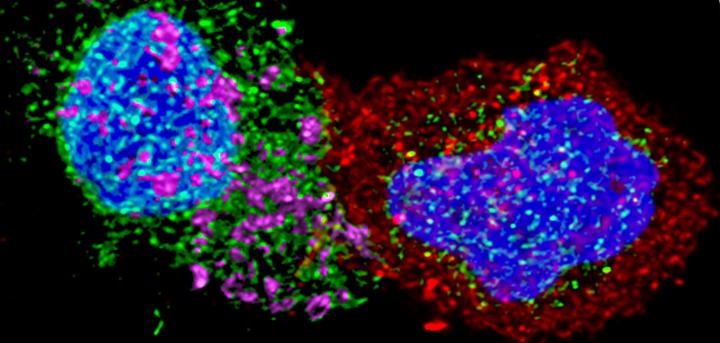
“Our research shows that even if the anti-HIV CD8 cells of non-controllers are relatively ineffective compared with those of controllers, the differences can be overcome,” Saez-Cirion concludes.
Metabolic reprogramming of immune cells is a strategy that is already being tested in clinical trials for cancer treatment. The scientists hope to be able to test the anti-HIV capabilities of the strategy in vivo in the near future.
Image: CD8 lymphocytes (red) of HIV controller patients in contact with CD4 cells (green) infected with HIV. The cell nuclei are in blue. In pink, a cytotoxic molecule secreted by CD8 cells to destroy CD4 cells. Image courtesy of Anastassia Mikhailova / Institut Pasteur.