Considering the ever-growing percentage of bacteria that are resistant to antibiotics, interest in the medical use of plasma is increasing. In a study published today in the Journal of the Royal Society Interface, researchers investigated whether bacteria may develop resistance against plasmas, too. The research team, based at Ruhr University Bochum, identified 87 genes of the bacterium Escherichia coli that potentially protect against effective components of plasma.
Plasmas are created from gas that is pumped with energy. Today, plasmas are already used against multi-resistant pathogens in clinical applications—for example, to treat chronic wounds. “Plasmas provide a complex cocktail of components, many of which act as disinfectants in their own right,” explains senior author Julia Bandow.
In order to find out whether bacteria would develop resistance against the effects of plasmas, the researchers analyzed the entire genome of the model bacterium E. coli to identify existing protective mechanisms. “Resistance means that a genetic change causes organisms to be better adapted to certain environmental conditions,” Bandow says. “Such a trait can be passed on from one generation to the next.”
Search Antibodies Search Now Use our Antibody Search Tool to find the right antibody for your research. Filter
by Type, Application, Reactivity, Host, Clonality, Conjugate/Tag, and Isotype.
For their study, the researchers used knockout strains of E. coli—strains that were missing one specific gene in their genome. They exposed each mutant to the plasma and monitored whether the cells continued to proliferate following the exposure.
“We demonstrated that 87 of the knockout strains were more sensitive to plasma treatment than the wild type that has a complete genome,” says first author Marco Krewing.
Subsequently, the researchers analyzed the genes missing in these 87 strains and determined that most of those genes protected bacteria against the effects of hydrogen peroxide, superoxide, and nitric oxide.
“This means that these plasma components are particularly effective against bacteria,” Bandow elaborates. However, it also means that genetic changes that result in an increase in the number or activity of the respective gene products are more capable of protecting bacteria from the effects of plasma treatment.
The team demonstrated that this is indeed the case. The heat shock protein Hsp33, encoded by the hslO gene, protects E. coli proteins from aggregation when exposed to oxidative stress. “During plasma treatment, this protein is activated and protects the other E. coli proteins—and, consequently, the bacterial cell,” Bandow says.
An increased volume of this protein alone results in a slightly increased plasma resistance. Considerably stronger plasma resistance can be expected when the levels of several protective proteins are increased simultaneously.
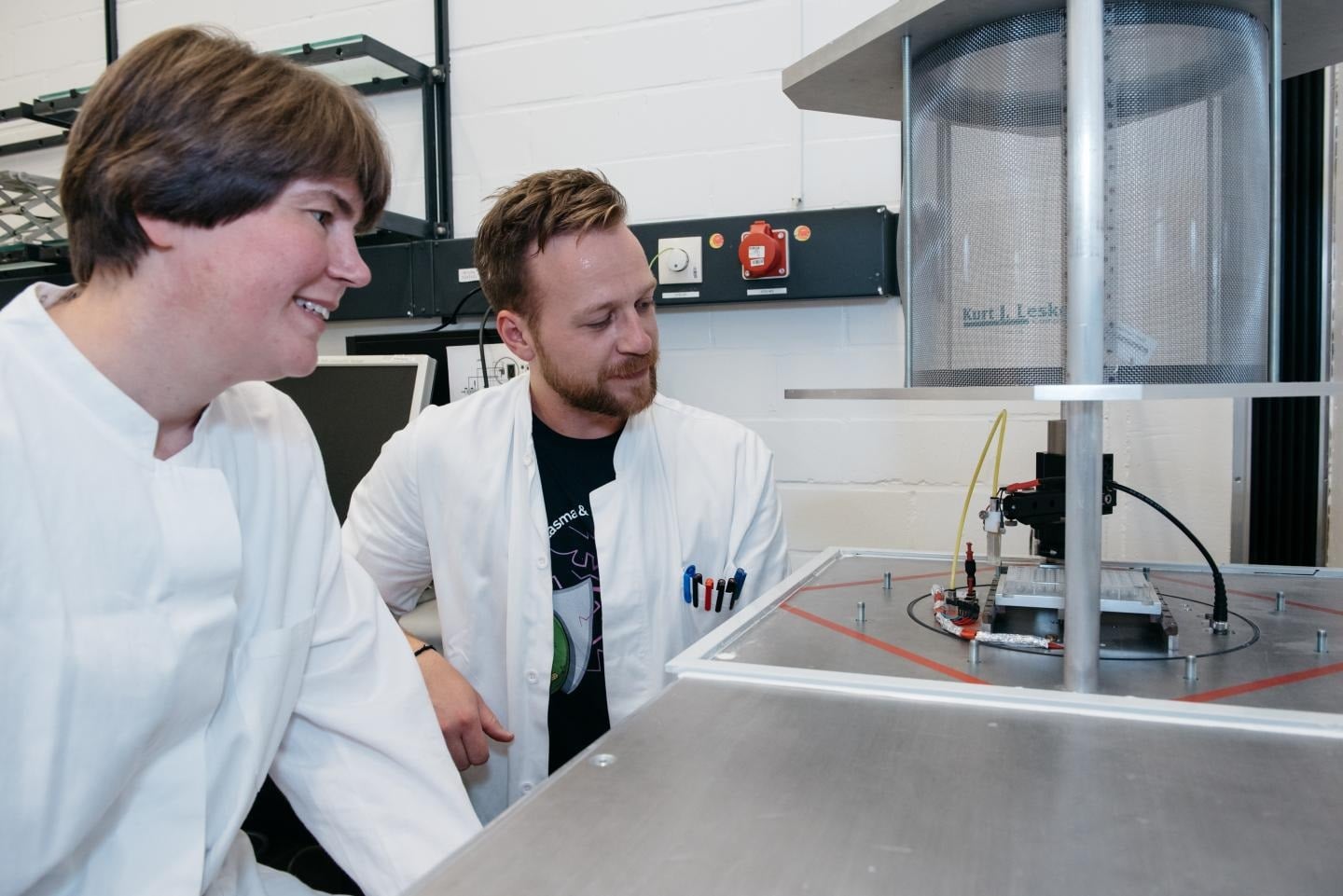
Image: Julia Bandow and Marco Krewing have investigated bacteria under the influence of plasmas. Image courtesy of Daniel Sadrowski.