Researchers have identified a genetic mutation that causes a fatal reaction to Hepatitis A virus (HAV) infection. The mutation is in the IL18BP gene, and it causes the body’s immune system to attack and kill healthy liver cells. Targeting its affiliated pathway could prevent the deaths of patients suffering rapid liver failure in response to viral infection. The results were published today in Journal of Experimental Medicine.
HAV infects the liver and usually causes a mild illness that clears up in a matter of weeks. But as many as 1 in 200 HAV patients suffer a much more severe response known as fulminant viral hepatitis (FVH). FVH is characterized by a rapid loss of liver tissue and catastrophic liver failure, resulting in the release of toxins that damage the brain. The condition is usually fatal unless the patient receives a liver transplant.
A team of researchers led by Professor Jean-Laurent Casanova at The Rockefeller University in New York identified an 11-year-old girl in France who died of FVH after becoming infected with HAV. The researchers sequenced the girl’s DNA and discovered that she carried identical mutations in both copies of the IL18BP gene, which encodes a protein called interleukin-18 binding protein (IL-18BP).
Search Antibodies Search Now Use our Antibody Search Tool to find the right antibody for your research. Filter
by Type, Application, Reactivity, Host, Clonality, Conjugate/Tag, and Isotype.
IL-18BP can bind and neutralize interleukin-18 (IL-18)—a cytokine produced to initiate an immune response. The team determined that the mutation identified in the patient’s IL18BP gene prevented the IL-18BP protein from neutralizing IL-18.
To understand how this might affect the body’s response to HAV infection, the researchers incubated human liver cells with Natural Killer (NK) cells—immune cells that target virally infected cells. They discovered that, in the absence of IL-18BP, IL-18 enhanced NK cells’ ability to target and kill liver cells, whether they were infected with HAV or not. Addition of IL-18BP blocked this IL-18-induced toxicity, suggesting that IL-18BP usually prevents an excessive reaction to HAV infection.
“Our findings provide a proof of principle that FVH can be caused by inborn errors in single genes,” Casanova says. “Human IL-18BP injections have been approved for clinical use for indications unrelated to liver conditions and has been proposed as a treatment for preventing acetaminophen-induced liver damage. Neutralizing IL-18 with IL-18BP might be beneficial to patients with FVH caused by HAV and possibly other viruses as well.”
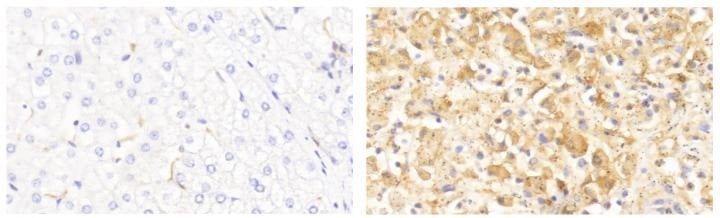
Image: IL-18 levels (indicated by brown staining) are low in the liver of a healthy individual (left) but are drastically elevated in the liver of a young girl with fulminant viral hepatitis resulting from a mutation in the IL18BP gene (right). Image courtesy of Belkaya et al., 2019.