Organoids offer great promise for studying disease in humans, unfortunately each human brain cell they generate is unique, which means they cannot be used easily to compare differences between diseased and control brain tissues. Scientists at Harvard University and the Broad Institute's Stanley Center for Psychiatric Research say they have addressed that issue with a new method that consistently grows the same types of cells, in the same order, as the developing human cerebral cortex. Their research is described in a paper published today in Nature.
"Organoids have dramatically advanced our ability to study the human developing brain," explained senior author Paola Arlotta. "But until now, each one has been its own snowflake, making its own special mix of cell types in a way that could not have been predicted at the outset. We solved that problem."
Search Antibodies Search Now Use our Antibody Search Tool to find the right antibody for your research. Filter
by Type, Application, Reactivity, Host, Clonality, Conjugate/Tag, and Isotype.
Building on seminal work led by the late stem cell biologist Yoshiki Sasai, the team created organoids that are virtually indistinguishable from one—even when grown for longer than six months in the laboratory. In addition, under specific culture conditions, the organoids were healthy and able to develop long enough to produce a broad spectrum of cell types normally found in the human cerebral cortex. These advances mean that brain organoids can now be used as viable experimental systems to study diseases in patient tissues directly, and to compare different drug effects on human brain tissues.
The researchers focused on organoids of the cerebral cortex. "We made organoids from multiple stem cell lines, from both male and female origins—so their genetic backgrounds were different," explained lead author Silvia Velasco.
Human brain tissues grow very slowly. In this study, after six months the organoids had grown to three millimeters across. In the largest single-cell RNA sequencing experiment in brain organoids to date, the researchers grouped cells based on which genes were expressed at different stages. Using computational models for big data analysis, they compared each group to the cell types that develop in the embryonic cerebral cortex.
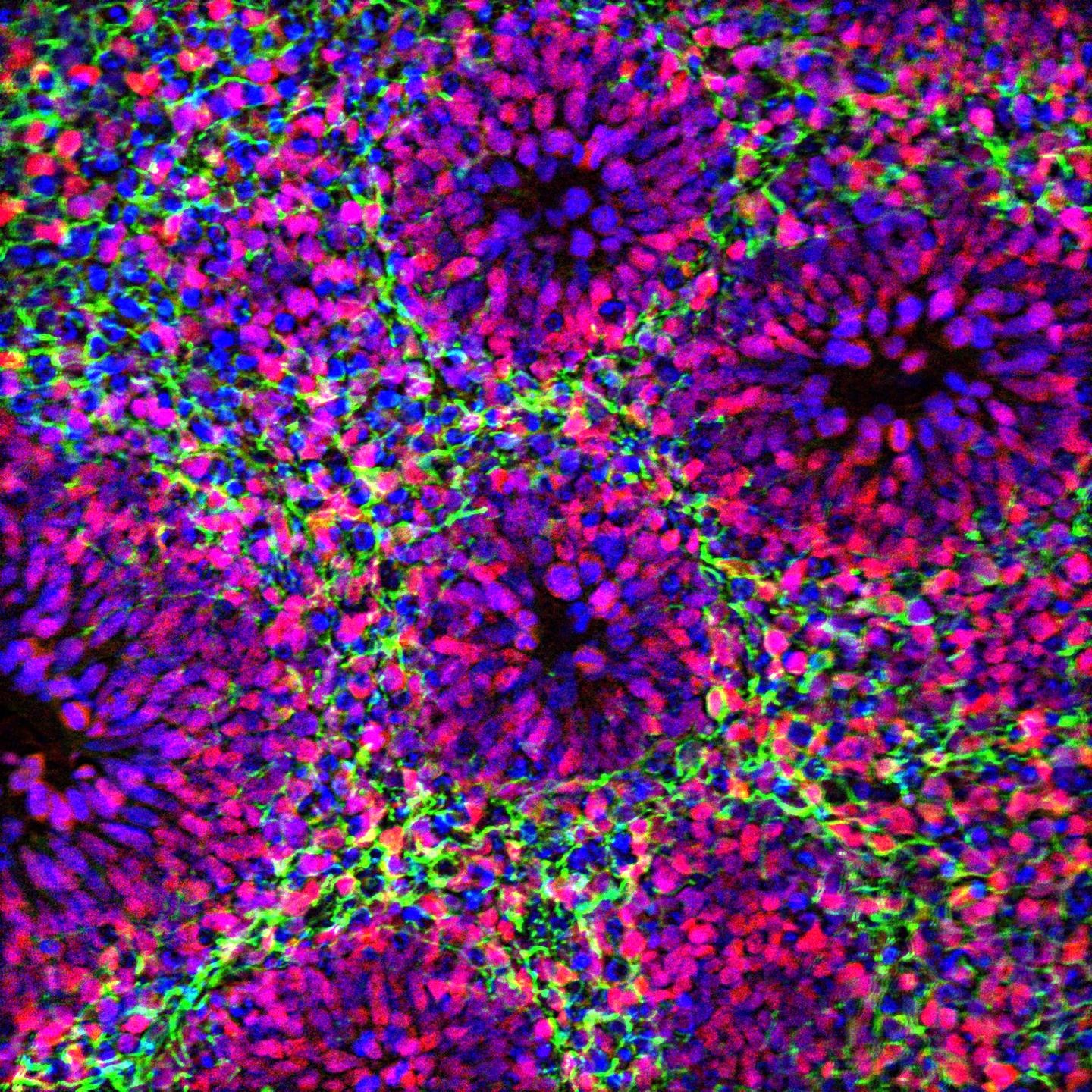
"Despite the different genetic backgrounds, we saw that the same cell types were made in the same way, in the correct order and, most importantly, in each organoid," said Velasco. "We were really excited that this model gave us such consistency."
Image: After one month of growing in the lab, a brain organoid contains clusters of cells that will develop into neurons. Image courtesy of Paola Arlotta laboratory, Harvard University.