As an organism grows and responds to its environment, genes in its cells are constantly turning on and off. Evidence is mounting that these changes in gene expression can be passed to offspring, but the mechanism has been unknown. In a study published today in Nature Communications, researchers at UC Santa Cruz demonstrate that epigenetic information carried by parental sperm chromosomes can cause changes in gene expression and development in the offspring.
In their experiments with C. elegans, the researchers have focused on modifications to specific amino acids in the tails of histone proteins. According to senior author Susan Strome, the new study addresses a central question in the field of epigenetics. “It’s a very direct question: Does inheriting sperm chromosomes with altered histone packaging of the DNA affect gene expression in the offspring? And the answer is yes.”
Search Antibodies Search Now Use our Antibody Search Tool to find the right antibody for your research. Filter
by Type, Application, Reactivity, Host, Clonality, Conjugate/Tag, and Isotype.
Researchers have focused on epigenetic inheritance in the paternal line because the sperm contributes little more than its chromosomes to the embryo. The egg contains many other components that may influence the development of the embryo, making it harder to tease out epigenetic effects in the maternal line.
First author Kiyomi Kaneshiro says that C. elegans is a good model for studying this question because histone packaging is fully retained in the worm’s sperm chromosomes. In humans and other mammals, histone packaging is only partially retained in sperm. In her experiments, Kaneshiro selectively removed a specific histone mark from sperm chromosomes and then fertilized eggs with the modified sperm.
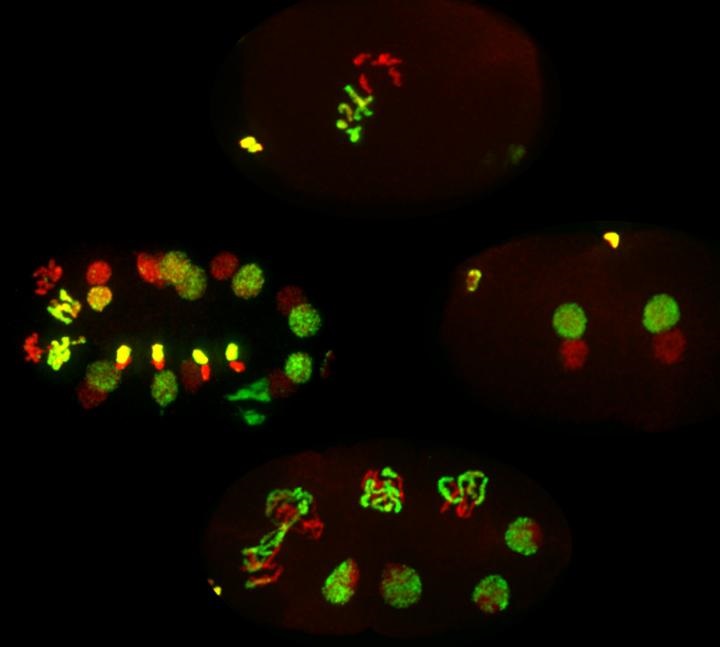
“The dads were British and the moms were Hawaiian, and there are enough differences between them that we could distinguish between the two parental genomes in the cells of their offspring,” Kaneshiro says. “Through this hybrid system, we were able to see differences in gene expression that were a direct result of the changes in histone marks on the sperm chromosomes.”
The new findings show that inherited epigenetic marks affect gene expression and development. But the study involved artificially changing the marks on the sperm chromosomes. What remains to be understood is how environmental effects on an adult organism could alter epigenetic marks in its germline cells, making it possible for those environmental effects to be transmitted to subsequent generations.
Image: In these C. elegans embryos, only chromosomes inherited from the egg are stained green. All chromosomes are stained red for DNA. By distinguishing between egg- and sperm-inherited chromosomes, researchers were able to track the effects of epigenetic marks carried by the sperm chromosomes. Image courtesy of K. Kaneshiro.