Fruit flies impart only a portion of the genetic building blocks their offspring need to survive. The rest must be produced by the fertilized egg in its first few steps of growth. According to scientists at Princeton University, this seemingly unnecessary withholding, controlled by an enzyme known as RNR, is actually key to the embryo's survival. Too much material early on leads to disaster for the fledgling lifeform.
"This study shows us how fragile development can be," said Stanislav Shvartsman, professor of chemical and biological engineering. "We asked the question, 'Why does the mother have to be so frugal?'" The problem led Shvartsman to test what happens when an embryo inherits an abundance of these building blocks. The answer was not pretty. "We realized, if you do not limit the supply, you create a temporal conflict that disrupts multiple processes in the embryo," he said.
In a study published today in Current Biology, the team tracked two groups of flies' embryonic development: one with a normal supply of DNA building blocks and one with around 10 times that amount. The results showed that, when more nucleotides were available to the embryo from the start, its DNA replication mechanism worked at breakneck speeds, running roughshod over the processes that followed and resulting in major defects later on.
Search Antibodies Search Now Use our Antibody Search Tool to find the right antibody for your research. Filter
by Type, Application, Reactivity, Host, Clonality, Conjugate/Tag, and Isotype.
Nareg Djabrayan, first author of the paper, likened the replication process to a machine. "When you provide that machine with too much of a certain input, its speed limit is broken," he said. "It goes too fast. And it messes with the other things that have to happen at the same time."
It turns out that the maternal withholding, quantified in previous work, plays a major role in the timing of early life, providing a natural limit to the pace of development. In the end, those flies that started out with a surplus of basic ingredients could not develop into a viable organism.
The findings mark a shift in thinking for researchers who study the control of genomes in transition from mother to offspring, according to cell biologist Stefano Di Talia of Duke University. "This paper is important because it shows that tight control of nucleotide levels is not only energetically favorable but also absolutely required for embryonic development to proceed normally," he explained.
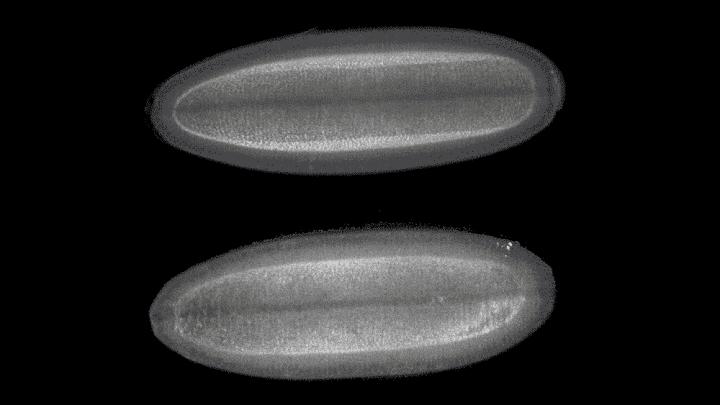
Images from a scanning electron microscope show the midline of the mutant fly (below) go sideways at morphogensis, just as the embryo begins to take shape. Compare that to the normal development at the same stage (above). Once this defect occurs, the embryo cannot develop further. Images courtesy of Stanislav Y. Shvartsman.