Data released today by the European Centre for Disease Prevention and Control (ECDC) and European Food Safety Authority (EFSA) reveal that antimicrobials used to treat diseases that can be transmitted between animals and humans are becoming less effective. The joint report, which presents the data collected from 28 EU Member States from humans, pigs, and calves under one year of age, confirms the rise in antibiotic resistance already identified in previous years.
“The report released today should ring—again—alarm bells. It shows that we are entering into a world where more and more common infections become difficult—or even sometimes impossible—to treat,” says Vytenis Andriukaitis, EU Commissioner for Health and Food Safety. “However, ambitious national policies in some countries limiting antimicrobial use have led to a decrease of antimicrobial resistance. So before the alarm bells become a deafening siren, let’s make sure that we increasingly act all together, in every country and across the public health, animal health and environment sectors under the One Health approach umbrella.”
Search Antibodies Search Now Use our Antibody Search Tool to find the right antibody for your research. Filter
by Type, Application, Reactivity, Host, Clonality, Conjugate/Tag, and Isotype.
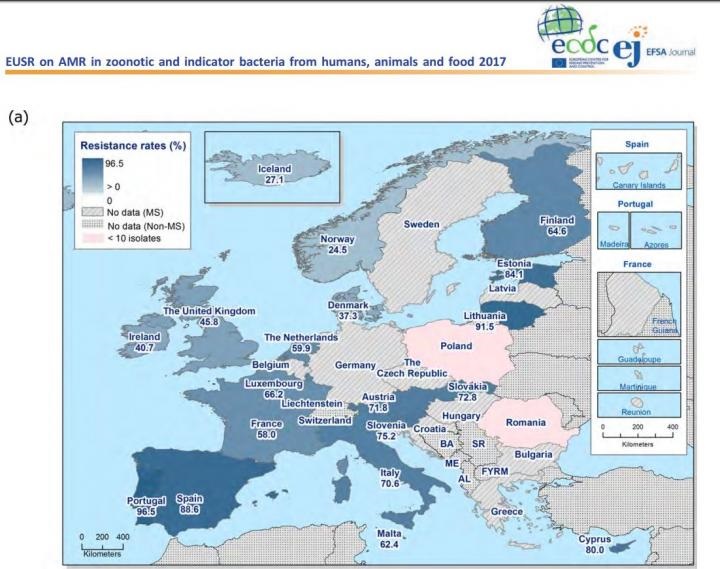
According to the report, which refers to 2017 data, resistance to fluoroquinolones (such as ciprofloxacin) is so high in Campylobacter bacteria in some countries that these antimicrobials no longer work for the treatment of severe campylobacteriosis cases.
Most countries reported that Salmonella in humans is increasingly resistant to fluoroquinolones. Multidrug resistance (resistance to three or more antimicrobials) is high in Salmonella found in humans and animals, particularly in S. Typhimurium. In Campylobacter, high to extremely high proportions of bacteria were found to be resistant to ciprofloxacin and tetracyclines. However, combined resistance to critically important antimicrobials was very low to low in Salmonella and Campylobacter from humans and animals and in indicator E. coli from animals.
“We have seen that when Member States have implemented stringent policies, antimicrobial resistance has decreased in animals,” says Marta Hugas, EFSA's Chief Scientist. “Annual reporting by European and national agencies includes noteworthy examples. This should serve as an inspiration for other countries.”
In June 2017, the European Commission adopted the EU One Health Action Plan against Antimicrobial Resistance, calling for effective action against this threat and recognizing that it needs to be tackled in human and animal health and in the environment. The prudent use of antimicrobials is essential to limiting the emergence and spread of antibiotic-resistant bacteria in humans and animals.
Image: The highest proportion of resistance was reported by countries in southern and eastern Europe and in the Baltic, whereas countries in northern and central parts of Europe reported lower resistance levels. When the level of resistance to an antibiotic in Campylobacter from humans is above 70%, it can no longer be regarded as effective treatment. Image courtesy of ECDC/EFSA, 2019.