A joint UCLA/Caltech team has shown that it is possible to obtain the structures of small molecules, such as certain hormones and medications, in as little as 30 minutes, using micro-electron diffraction (MicroED).
According to a study published in ACS Central Science earlier this month, the process requires much less preparation time than expected. Unlike related technique—some of which involve growing crystals the size of salt grains—this method can work with run-of-the-mill starting samples, sometimes even powders scraped from the side of a beaker.
"We took the lowest-brow samples you can get and obtained the highest-quality structures in barely any time," says Caltech professor of chemistry Brian Stoltz, who is a co-author on the new study. "When I first saw the results, my jaw hit the floor."
The reason the method works so well on small-molecule samples is that while the samples may appear to be simple powders, they actually contain tiny crystals, each roughly a billion times smaller than a speck of dust. Researchers knew about these hidden microcrystals before, but did not realize they could readily reveal the crystals' molecular structures using MicroED. "I don't think people realized how common these microcrystals are in the powdery samples," says Stoltz.
The results have implications for chemists wishing to determine the structures of small molecules including certain chemicals found in nature, some biological substances like hormones, and a number of therapeutic drugs. Possible applications of the MicroED structure-finding methodology include drug discovery, crime lab analysis, medical testing, and more.
"The slowest step in making new molecules is determining the structure of the product. That may no longer be the case, as this technique promises to revolutionize organic chemistry," says Robert Grubbs, Caltech's Victor and Elizabeth Atkins Professor of Chemistry and a winner of the 2005 Nobel Prize in Chemistry, who was not involved in the research. "The last big break in structure determination before this was nuclear magnetic resonance spectroscopy, which was introduced by Jack Roberts at Caltech in the late '60s."
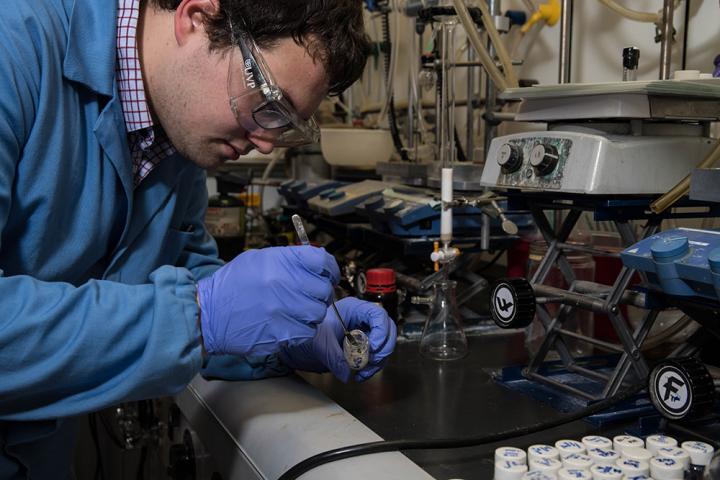
Image: Graduate student Tyler Fulton prepares samples of small molecules in a lab at Caltech.