New simulations reveal that DNA flows inside a cell's nucleus in a choreographed line dance. The dancing DNA may play a role in gene expression, replication, and remodeling, though the exact effects remain unclear, researchers from the Flatiron Institute’s Center for Computational Biology reported this week in Proceedings of the National Academy of Sciences.
"Previous work mostly focused on what was going on at the microscale of DNA," says study co-author Michael Shelley, group leader for biophysical modeling and co-director of the Courant Institute's Applied Mathematics Laboratory at New York University. "People didn't really think about what was going on at the larger scale."
Shelley and colleagues simulated the motions of chromatin, the functional form of DNA inside the nucleus. Chromatin looks like beads on a string, with ball-like clusters of genetic material linked by strands of DNA. The researchers propose that molecular machines along the DNA cause segments of the chromatin to straighten and pull taut. This activity aligns neighboring strands to face the same direction. That alignment, in turn, results in a cascading waltz of genetic material shimmying across the nucleus.
Using computer simulations, the researchers modeled how contraction and extension affected a jumble of chromatin confined within a spherical nucleus. When the lengths of DNA contracted, the resulting flow pointed nearby strands in a different direction, blocking any choreographed movements. Extension created streams of fluid that aligned nearby DNA in the same direction. That alignment resulted in a cascading effect that shifted large patches of DNA in the same direction.
"It's like part of the nucleus suddenly decides that we're all going to move over this way a little, then another bit says we're all going to move over this way," Shelley says. "The chromatin sort of wanders around." This DNA shimmy could help distribute throughout the nucleus the molecular machinery responsible for expressing a particular gene, Shelley proposes.
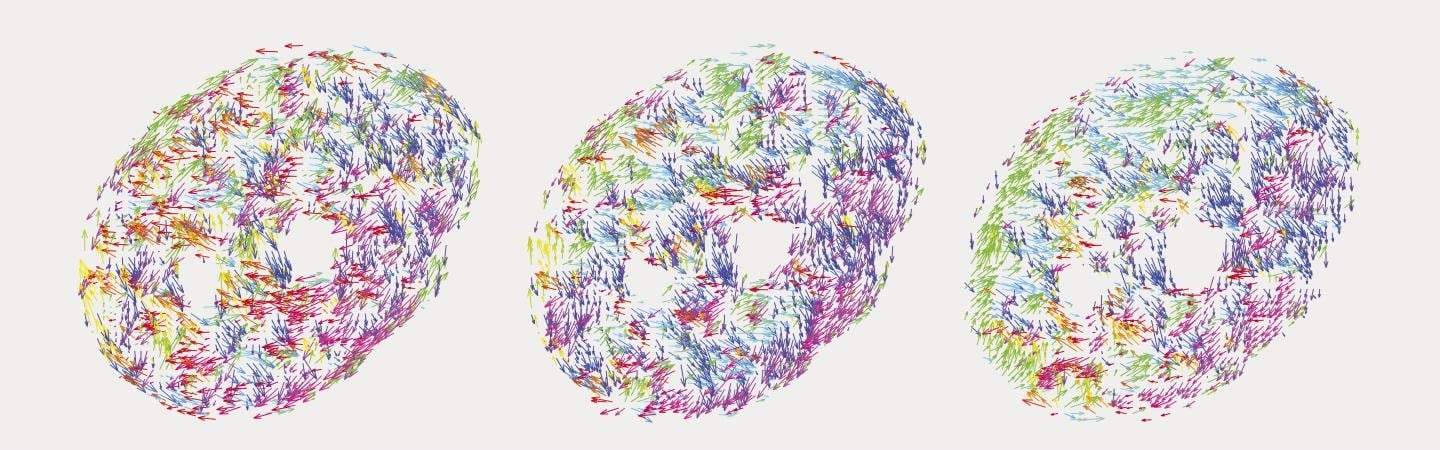
Image: Lengths of DNA meander around the nucleus of a human cell, as seen in these snapshots of experimental data. (Colored arrows denote the direction of movement.) New simulations shed light on how and why the DNA moves. Image courtesy of D. Saintillan, M.J. Shelley and A. Zidovska/PNAS 2018.