The definitive architecture of the mammalian body is established shortly after implantation of the embryo in the uterus. The antero-posterior, dorso-ventral, and medio-lateral axes of the body become organized under the control of gene networks that coordinate the transcription of DNA in various regions. In a study published today in Nature, an international team of researchers report the ability of mouse stem cells to produce pseudo-embryos that display similar capacities.
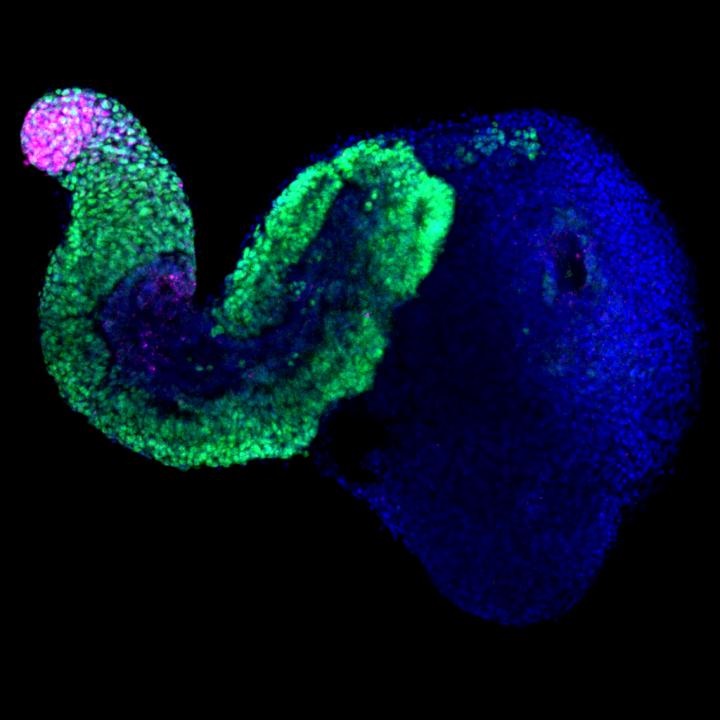
According to the research team, under certain conditions, murine embryonic stem cells can assemble into three-dimensional aggregates that keep elongating in culture. These entities, called "gastruloids," display developmental features comparable to the tail end of embryos aged 6–10 days, and their three main axes are formed according to a gene expression program similar to that of embryos. Gastruloids thus possess remarkable potential as models of the early stages of embryonic development in mammals.
The researchers identified and quantified the RNA transcribed from gastruloids and compared the expressed genes with those of mouse embryos at comparable stages of development.
"The complexity of gene expression profiles increases over time, with the appearance of markers from different embryonic cell lineages, much like the profiles observed in control embryos," notes co-first author Naomi Moris of the Cambridge team.
During the formation of the gastruloids' three axes, the researchers could visualize an amazing property: The 'architect' Hox genes, which are normally activated in a precise sequential order in the embryo, were activated equally well in gastruloids grown in vitro.
"The implementation of the Hox gene network over time, which mimics that of the tail of the embryo, confirms the remarkably high level of self-organization of gastruloids," explains co-first author Mehmet Girgin of EPFL.
These artificial pseudo-embryos will in some cases offer an alternative method to animal experimentation, in accordance with the 3Rs—the principle that has been established internationally as the ethical approach to animal experimentation. It aims at reducing the number of animals used, refining experimental conditions to improve animal welfare, and replacing animal models with other experimental methods whenever possible.
Image: Seven-day-old gastruloid. The cell nuclei are marked in blue. Neural progenitor cells (green) are distributed along the antero-posterior axis. Progenitor cells of the tail bud (pink) are confined to the posterior extremity of the gastruloid and indicate the direction of its elongation. Image courtesy of © Mehmet Girgin, EPFL.