Researchers have developed a powerful method for exploring the properties of mysterious molecules called long non-coding RNAs (lncRNAs), some of which play major roles in cancer and other serious conditions. Until now, scientists had characterized only a few hundred of the tens of thousands of lncRNAs produced in human cells.
Less than 2% of the genome codes for RNA that will be translated into protein. If a non-coding RNA is longer than 200 nucleotides, it is classified as a lncRNA. In research published yesterday, UNC scientists discovered a relationship between the sequence of lncRNAs and their function, and they developed an algorithm that quickly predicts a lncRNA’s likely function.
One reason biologists have been slow to understand lncRNAs is that their function is not readily apparent from their nucleotide sequence. Mauro Calabrese, Ph.D., assistant professor of pharmacology, and his team tried to decipher the obscure relationship between lncRNA sequence and function. They started with two key clues: First, there is evidence that lncRNAs function mainly by binding to proteins, and second, proteins bind to RNAs at short sequences.
"We reasoned that the presence of protein-binding sequences in a lncRNA would be more important than their relative positioning within the lncRNA," Calabrese said. "This notion ended up being true, and allowed us to succeed where more traditional approaches have failed."
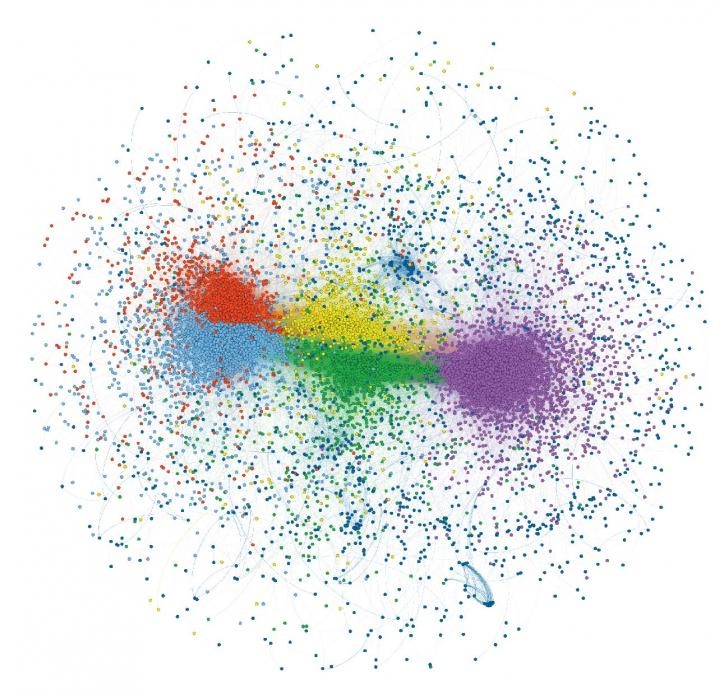
The team developed a computer-based method called SEEKR to find and compare protein-binding sequences they called "kmers" in lncRNAs. They found that about half of all human and mouse lncRNAs could be grouped into five different communities, based on similarities in their kmer content. Surprisingly, the team found that kmer-content communities were often highly similar even among distantly related species.
Finally, the scientists synthesized completely artificial lncRNAs, designing them to include kmers found in Xist, a lncRNA that is important for female development, while making sure that the molecules' overall sequences were unlike those of any known lncRNA. They applied the SEEKR algorithm to these artificial lncRNAs and found that those with the highest predicted functional similarity to Xist had the highest actual functional similarity in a simple test-tube test of Xist-like activity.
Image: Communities of long non-coding RNAs. Mauro Calabrese and colleagues can now categorize long non-coding RNAs by their function to learn more about the roles of this type of RNA in health and disease. Image courtesy of the Calabrese Lab, UNC School of Medicine.