A team of researchers led by the Wyss Institute at Harvard University and Brigham and Women's Hospital have managed to engineer intestinal microbes that can communicate within the gut. The published study in ACS Synthetic Biology highlights the potential of repurposing quorum sensing to manipulate signaling processes within the microbiome.
 "In order to improve human health through engineered gut bacteria, we need to start figuring out how to make the bacteria communicate," said study first author Suhyun Kim. "We want to make sure that, as engineered probiotics develop, we have a means to coordinate and control them in harmony."
Bacteria use quorum sensing in nature to coordinate gene expression based on the density of the surrounding population. Quorum sensing mediated by the small molecule acyl-homoserine lactone (acyl-HSL) is widely used, although not yet observed within the gut microbiome. Using genetic engineering, the team sought to repurpose this mode of communication using two bacteria: the native gut microbe Escherichia coli and an attenuated pathogen, Salmonella enterica.
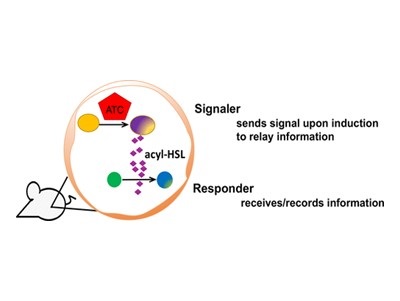
The team designed genomic circuits for two signaling roles: a “signaler” and a “responder.” The signaler contains luxl, a gene that is turned on by a stimulating compound to produce acyl-HSL. The responder contains a gene that is turned on by acyl-HSL to then express the reporter LacZ, as well as a positive feedback element to prolong the LacZ expression.
To test the signaling system in vivo, the team gave the mice signaler S. Typhimurium bacteria and E. coli responder bacteria. In the results, the team observed that all of the mice successfully displayed signs of bacterial signal transmission. This confirmed that the engineered circuits allowed communication between different species of bacteria in the complex environment of the mammalian gut.
"Ultimately, we aim to create a synthetic microbiome with completely or mostly engineered bacteria species in our gut, each of which has a specialized function (e.g., detecting and curing disease, creating beneficial molecules, improving digestion, etc.) but also communicates with the others to ensure that they are all balanced for optimal human health," said study senior co-author Pamela Silver.
Image: The signaler circuit responds to the compound ATC to produce the quorum sensing signaling molecule, acyl-HSL. The responder expresses the reporter LacZ, allowing blue-colored bacterial growth. Image courtesy of Pamela Silver and ACS Synthetic Biology.