A team of neuroscientists from Nagoya University have discovered the signaling cascade that is activated to repair damaged axons in a C. elegans model. The experiments show that the molecules involved in repair are the same ones that drive neighboring cells to engulf apoptotic or dying cells. The repair vs. remove signal could potentially be differentiated by the length of time one key molecule remains active. The paper describing the findings is published in Nature Communications.
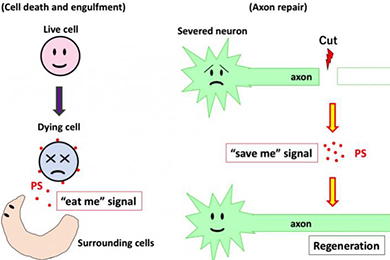
The CRISPR-Cas9 system was used to generate worms with mutations in the molecules potentially involved in the repair mechanism. The team used a laser to sever axons and then observed the molecular steps in worms with knocked out repair molecules. Fluorescent markers were used to monitor changes in the repair signaling cascade. When the axon was cut the lipid, phosphoatidylserine (PS), moved from inside to outside the cell with the help of an ABC transporter protein. TTR-11 protein binds to extracellular PS, triggering the integrin signaling pathway that leads to axon repair. PS is also known to be the signal that dying cells use to initiate phagocytosis by surrounding cells. The team notes that in apoptotic situations, PS is present until the dying cell is engulfed, however, with damaged axons, PS only remains outside the cell for approximately one hour. The researchers propose the difference in duration enables the cell to decide whether to remove the dying cell or to repair it.
 According to Naoki Hisamoto, "Now that we know how this system works in the relatively simple roundworm, we should eventually be able to extrapolate the findings to humans. This could provide us with a range of targets for pharmaceutical interventions to treat conditions like brain and spinal cord injuries, in which the human body is not able to repair damaged nerves."
Image: The dying cells secrete phosphatidylserine (PS), a kind of lipid acting as an "eat me" signal, into the extracellular space. PS is then recognized by the engulfing cells that eat the dying cells. The severed neurons, however, induce only the PS secretion without dying. The secreted PS then acts as a "save me" signal that accelerates axon regeneration of the severed neurons. Image courtesy of Naoki Hisamoto.