Computational biophysicists from University of Massachusetts Amherst say they have determined how cells regulate big potassium (BK) channels, which are integral for coupling electrical signaling to calcium-mediated events such as muscle contraction and neural excitation.
A key puzzle over the past 30 years has been trying to understand how cells close, or gate, BK channels, which have an unusually large central pore. In more typical-sized pores, the channel proteins generally contain structures that move into position to physically close the ion passage when ordered. But findings by others had shown that, inexplicably, the large central pore in BK channels "seems to remain wide open in both activated and deactivated states."
In a Nature Communications paper published today, Jianhan Chen and his team demonstrate that a physical gate is not required for closing BK channels. Instead, a phenomenon known as "hydrophobic dewetting" gives rise to a vapor phase in the pore's central cavity to block intracellular access to the selectivity filter.
The gate mechanism in BK channels they have been studying is "drastically different from what has been observed in other ion channels," the authors point out. "We believe that this work represents a paradigm shift in our thinking of regulation and gating of BK channels," and is "one of the first few examples of a true 'hydrophobic gate,' where the barrier to ion permeation arises directly from dewetting transitions."
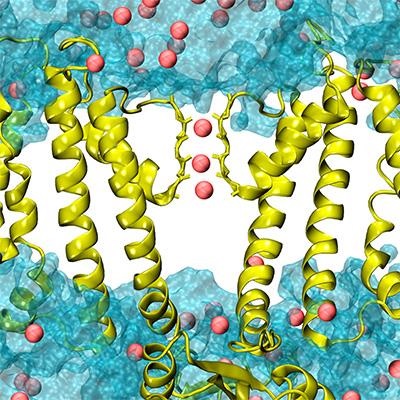
The team used computational modeling and physics-based atomistic simulations for this work. They found the hydrophobic gating mechanism is also consistent with scanning mutagenesis studies showing that modulation of pore hydrophobicity is correlated with activation properties.
Image: The central pore of big potassium (BK) channels, shown here in yellow, become depleted of water, shown in blue, to block the passage of potassium ions, shown as pink spheres. Image courtesy of UMass Amherst/Jianhan Chen.