Neuroinvasive viruses, such as alpha herpesvirus and rabies virus, travel across neuronal axons in order to reach the neuron cell bodies of the peripheral or central nervous system. A study published in PLOS Pathogen discovers how such viral neuroinvasion is regulated and, importantly, how the process may be blocked. The work comes from a team led by Princeton University.
 "Transport to the neuronal cell body is not a passive process, but an active one relying on the neuron's own motor proteins and microtubule tracks," said study senior co-author Lynn Enquist. "Virus particles must engage this machinery for efficient transport in axons, otherwise infection cannot start."
Previous work had shown that herpesviruses activate the host’s neuronal transport machinery by stimulating protein synthesis at infected nerve terminals. Then, by treating with protein synthesis inhibitors or interferon proteins, the axonal transport could be restricted. The study sought to determine if a similar process might also apply to the rabies virus.
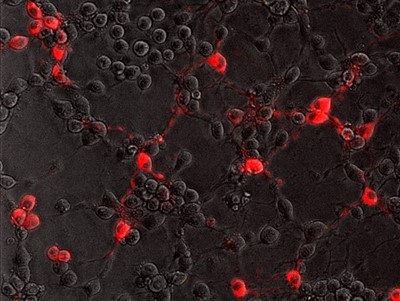
The team tested these conditions in a rodent neuroblastoma cell model. The virulent strain of the virus was tagged with a red fluorescent fusion protein, mCherry, and observed in real time by live-cell fluorescence microscopy.
Contrary to alpha herpesvirus infections, the team discovered that interferons had no effect on rabies virus transport. The reason may be due, in part, to the ability of the virus to hide out in cellular endosomes. However, exposure to a translation elongation inhibitor, emetine, proved to be successful in blocking viral transport. Endosomes that harbored the virus were either completely immobilized or were considerably slowed down by emetine.
"Emetine has been used to treat amoebic dysentery," said leading study co-author Orkide Koyuncu. "In the laboratory, it is widely used to inhibit protein synthesis but there are recent reports indicating that emetine has anti-viral effects that are independent of protein synthesis inhibition. Our study shows that this drug can inhibit rabies virus invasion of the nervous system through a novel mechanism that hasn't been reported before."
Image: Rodent neuroblastoma cells appear red after infection with a rabies virus that expresses a fluorescent fusion protein. Viral proteins are present in the round cell bodies as well as the extended neural processes. Image courtesy of Margaret MacGibeny.