Cancer cells have the ability to acidify their environment, and as a consequence, the cellular interior can be alkalized. This reverse pH gradient is a hallmark of cancer metabolism, although it remains unclear how such intracellular alkalization can affect cellular function. A new study published in Nature Communications investigates the process using computation, hereby revealing possible new approaches in cancer therapy.
 “By reconstructing and integrating enzymatic pH-dependent activity profiles into cell-specific genome-scale metabolic models, we develop a computational methodology that explores how intracellular pH (pHi) can modulate metabolism,” reports the study, jointly led by researchers from Institute for Research in Biomedicine (IRB Barcelona) and the University of Maryland.
The computational model was developed from hundreds of thousands of data from previous biochemical assays and a database on the gene expression of cancer cells. This allowed the research team to generate pH-activity profiles for the majority of metabolic enzymes in the human proteome. They then sought to answer the hypothesis: if cancer cells proliferate easily in an alkaline environment, then they would be more vulnerable under acidic conditions.
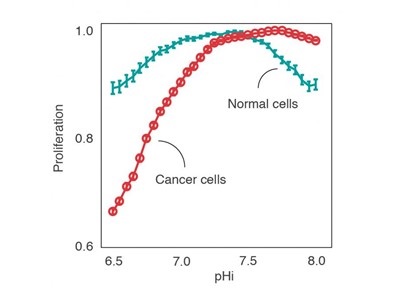
From their in silico predictions, the team found that intracellular alkaline pH maximizes cancer cell proliferation, particularly by coupling to the metabolic processes of glycolysis and adaptation to hypoxia. More importantly, it appears that the reverse—acidic intracellular pH—downplays these adaptations, leading to reduced tumor cell growth.
While still largely theoretical, the team believes the enzymes identified in this study may serve as potential anti-cancer targets. Among these are the glycolytic enzymes GAPDH (glyceraldehyde 3-phosphate dehydrogenase) and GPI (glucose-6-phosphate isomerase).
"This work is still very academic, but we believe that some of the targets identified are ready to be tested in animals, thus allowing us to move into more advanced pre-clinical trial stages," said study first co-author Miquel Duran-Frigola.
Image: This is computational prediction of the proliferation of healthy and cancerous cells at different intracellular pH. Cancer cells proliferate well at basic pH, but at acidic pH they become vulnerable. Image courtesy of Miquel Duran-Frigola, IRB Barcelona.