Triple-negative breast cancer is highly aggressive and has no established method of targeted drug therapy. Currently, combination chemotherapy that uses cocktails of drugs is typically used to combat the cancer. However, there is yet no reliable way to predict which combinations, among hundreds of choices, will work effectively on each unique, individual patient.
 New computational work published in PLOS Computational Biology may provide a means to determine the best drug combination for individuals. This research aimed at personalized cancer treatment comes from a team at Monash University in Australia.
Triple-negative breast cancer (TNBC) cells can rapidly develop resistance to a single targeted drug by exploiting alternative signaling pathways. The team thus developed an algorithm to overcome this hurdle. Using protein and gene expression data from The Cancer Genome Atlas, the team tested drug combinations to determine success in people who had survived TNBC. The algorithm focuses on a key signaling pathway driven by oncogenic receptor kinases.
“Here we applied a systems modelling approach and developed a mechanistic model of the integrated EGFR-PYK2-c-Met signalling network to identify and prioritize potent drug combinations for TNBC,” the team noted. “Simulations of patient-specific models using public gene expression data of TNBC patients led to predictive stratification of patients into subgroups displaying distinct susceptibility to specific drug combinations.”
Given an individual’s gene expression data, the model aims to predict and prioritize specific drug combinations most likely to be potent against TNBC. The hope is that with proper modeling precious time is not lost in treating a patient with the wrong drugs. Through this method, the team has already identified a promising and previously unknown combination of two drugs.
"We hope to have this new combination in clinical trials in two to five years,” said study first author Lan K. Nguyen. He adds that the model can be adapted for other serious cancers, such as lung and melanoma, where pathway re-routing is also observed to evade drug therapy.
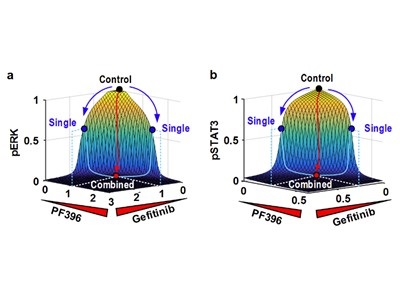
Image: 3D simulations of the normalized steady-state kinase (pERK and pSTAT3) levels to simultaneous increases of Gefitinib and PF396 concentrations. Image courtesy of Lan K. Nguyen and PLOS.