A review paper published last week in SLAS Discovery by GlaxoSmithKline researchers offers an informative guide to the established and emerging tools available for early drug discovery and screening.
While high-throughout screening (HTS) remains a mainstay in drug discovery, other approaches have emerged or evolved in the past decade that offer complementary strengths and weaknesses, and are increasingly applied in combination with, or in lieu of, HTS. The team reports that great success often can be achieved by combining different approaches in an integrated manner.
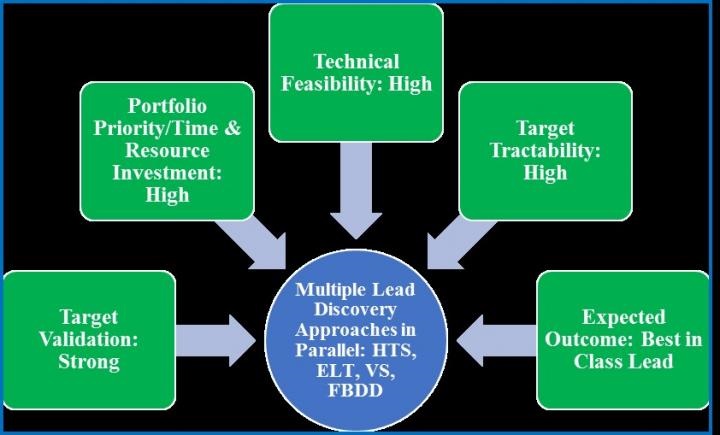
The paper, which can be accessed for free for a limited time, surveys the landscape of lead discovery tactics that researchers use today and explains how this toolbox of approaches is evolving as new science emerges, such as in the areas of complex cellular models and computational techniques. Case studies illustrate how integration of techniques like DNA-encoded library screening (ELT) and HTS, phenotypic and target-based screening, and virtual screening (VS) with experimental approaches can lead to successful outcomes and provide insights and synergies that would never have been obtained through one technique alone.
Image: An illustrative example of decisions leading to the initiation of a parallel integrated lead discovery effort. Image courtesy of Melanie Leveridge.