A research team has created a pocket-sized cell sorting device that uses a novel channel design to separate particles as small as 3µm. The design is made up of reverse wavy channel structures and utilizes sheathless inertial focusing technology to achieve size-based separation between target and non-target cells. The team used the sorting technology to separate breast cancer cells from whole blood samples. This initial research demonstrates its ability to potentially isolate rare circulating tumor cells (CTCs) providing a less invasive approach to cancer diagnosis. The paper describing the findings is published in Microsystems and Nanoengineering.
 CTCs are malignant cancer cells that originate from a solid tumor and move throughout the bloodstream but are extremely rare—there are low double-digit CTCs in 1 mL of whole blood. The ability to capture and analyze CTCs could enable clinicians to diagnose cancer before the disease becomes advanced. Inertial focusing has become of interest since it can be scaled to meet the high throughput demands of practical research and clinical use in addition to having a favorable capture rate, all common challenges of rare cell isolation.
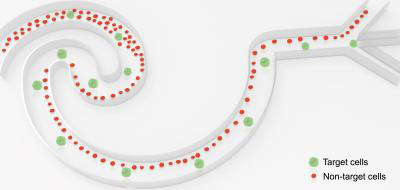
In this most recent study, the team’s device utilized inertial focusing in combination with a series of reverse wavy semi-circle channels that produce a periodically reversed hydrodynamic flow that is perpendicular to the main flow direction. The two forces come together to move particles laterally across the channel resulting in size-based separation of particles or cells. The device was used to successfully separate MCF-7 breast cancer cells from blood cells in whole blood that had been spiked with the cancer cells. The process was able to recover 89.72% of MCF-7 cells, enrich the cells, and maintain viability.
The principal investigator, Dr. Ye Ai said: "Compared to active methods, the passive inertial focusing with the use of hydrodynamic forces exhibit the merits of a simplified setup, high-throughput and low-energy consumption. Moreover, the linear array of these repeated wavy channel units also facilitates easy horizontal (2D) and vertical (3D) parallelization of multiple channels, which provides great potential for high-throughput cell sorting in practical biomedical applications."
Image: This is a schematic of size-based inertial cell sorting in a wavy channel unit before the trifurcated output. Differently sized biological cells can achieve distinct focusing behaviors, which thus result in effective size-based separation between target cells and non-target cells. Image courtesy of SUTD.