Researchers have discovered a mechanism that controls gene expression fluctuation during the early stages of zebrafish embryo development. Even though these are preliminary findings and much more research is needed, the study could eventually lead to treatments applied during embryonic growth that prevent future development of cancer and birth defects. The multi-institutional project included teams studying developmental systems in zebrafish. The vertebrate shares common genes with humans making it an ideal early human development model. The paper describing the study and results is published in Cell Reports.
The team focused on somitogenesis, the development stage where blocks of cells form along the embryonic axis and eventually form skeletal muscle and deep layers of skin, known as somites or segments. The vertebrate segmentation clock is a biological clock, or molecular oscillator, that regulates the periodicity of somite formation. By counting single gene transcripts of the zebrafish segmentation clock, the team determined that the clock genes had very low RNA levels, which indicated that gene expression variability during somitogenesis comes from extrinsic noise and not from the genes themselves.
It’s known that the Notch signaling pathway keeps these externally driven fluctuations in check acting as a control switch for cells developing into tissues. This study demonstrated Notch has the same role during zebrafish somitogenesis.
 "Our results suggest variability in gene expression is controlled by a balance between time delays and when cells are actively signaling in vertebrate tissue," says the study's principal investigator, Ertugrul Ozbudak, PhD. "Further investigation should shed light on the accuracy of natural development clocks in animals and humans, and this could help inspire the development of robust synthetic oscillators that might help prevent certain birth defects or cancers."
One example is the Hes family of genes which are activated by Notch during embryonic development and are involved in early development of the vertebral column. Hes genes also misbehave in individuals with rhabdomyosarcoma—a type of connective tissue-related cancer. This study suggests the possibility of controlling gene expression in early stages of development in order to prevent the occurrence of disease years later.
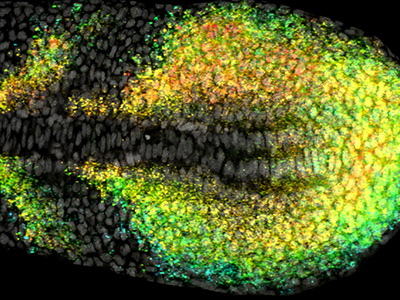
Image: This image highlights single RNA molecules that scientists counted in single cells in a developing zebrafish embryo. Genes in the embryo's segmentation clock oscillate, showing high and low expression along the axis of unsegmented tissues. RNA molecules are colored depending on their position in the tissue. The oscillations stop when groups of cells form segments. Cell nuclei are marked by the color gray. Scientists report in Cell Reports their research offer clues into how random gene fluctuations might be tamed during at the earliest stages of when life forms, which could one day help prevent birth defects or cancer. Image courtesy of Cincinnati Children's.