In latent tuberculosis (TB), individuals infected with Mycobacterium tuberculosis (Mtb) are able to tolerate chronic bacterial infection without developing the disease. Published findings in Science Immunology now provide a new cellular explanation in the mechanism driving this tolerance. The work, led by researchers from McGill University in Montreal, focuses on T cell metabolism.
 "We always thought that having more T cells would provide better protection against TB. Instead, we found that it could imbalance disease tolerance causing extensive tissue damage and ultimately killing the host," said study co-author Maziar Divangahi.
The team discovered that a mitochondrial protein, known as cyclophilin D (CypD), functions as a critical checkpoint of T cell metabolism. The protein controlled the expansion of activated T cells. In studies with mice, mutants lacking functional CypD led to increased specific T cell responses but did not particularly impact the burden of the bacterial infection. Instead, the increased T cell activation led to a more detrimental outcome. Mice became less tolerant of the disease and eventually succumbed to the infection.
"T cells are traditionally considered to be important in eliminating Mtb. However, we found that increasing T cell activation in mice by eliminating a metabolic checkpoint unexpectedly compromised host survival without any impact on the growth of Mtb," noted Divangahi.
"In contrast to conventional thinking, we show that T cells are essential for regulating the body's tolerance to Mtb infection,” said co-lead author Nargis Khan.
The team notes that in addition to resistance mechanisms that act directly on Mtb infection, hosts have also evolved strategies to tolerate the presence of the pathogen to limit disease severity. One such strategy, the team concludes, is driven by T cells and controlled by CypD.
"If we could understand the mechanisms of 'natural immunity' that controls TB in 90-95 percent of infected individuals," says Dr. Divangahi,"we will able to design a novel therapy or vaccine to substantially reduce the world wide burden of this ancient disease."
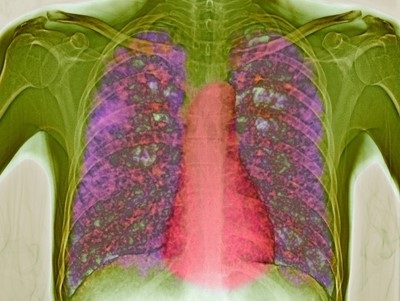
Image: A colored X-ray of a patient's chest showing disseminated, or miliary, tuberculosis (TB) in the lungs. The lungs contain lesions (tubercles, pink) consisting of infected dead tissue. Image courtesy of Du Cane Medical Imaging Ltd / Science Photo Library.