Researchers from the University Hospital of Basel have looked closer how the metabolites of bacteria influence the composition and function of mucosal-associated invariant T (MAIT) cells, which are found in the gut. Their work was published this week in Mucosal Immunology.
MAIT cells have been discovered to be naturally in large quantities in the gastrointestinal mucosa, skin, liver, and blood. Their specialty is to recognize microorganisms that live in humans and monitor their activity.
A group led by Gennaro De Libero and Petr Hruz has taken a look at how bacterial metabolites in a normal colon influence MAIT cells. They found that the MAIT cells were not all activated or at rest, but a mix of the two depending on the bacterial flora. It appears the cells tend to be stimulated by bacteria grown under low-oxygen and slow growth-phase. This environment is similar to the large intestine. MAIT cells can then directly influence local inflammation but also tissue healing and cell fitness in the gut by producing different messenger substances.
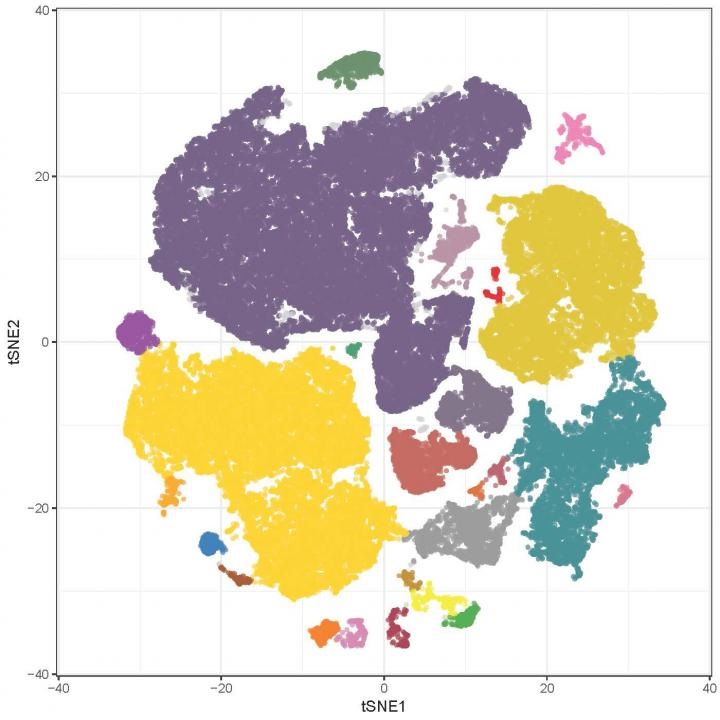 "Our results show that there is a fine balance occurring in the gut between microbial growth conditions, the production of stimulating metabolites and the response of MAIT defense cells," state the researchers. By keeping tabs on the metabolic state of enteric bacteria, MAIT cells can increase the effect of their function in immunosurveillance.
Image: Clusters of MAIT cells in human blood and colon biopsies, resulting from high-dimensional bioinformatics analysis. Subpopulations of these defense cells group into colored 'continents' according to the markers expressed by the cells. Image courtesy of the Department of Biomedicine, Tobias Rutishauser.