Most people can easily receive blood transfusions from donated blood. However, patients with blood disorders will often need frequent transfusions. Due to these frequent transfusions, those patients with blood disorders often develop an immune response to the donated blood because of the incompatibility of some of the blood group antigens. Scientists at the NIHR Blood and Transplant Research Unit (BTRU) have found a way to fix that. Using CRISPR-Cas9, this team has successfully been able to create cell lines and alter genes to prevent an immune reaction to the blood group antigens. Their work was published recently in EMBO Molecular Medicine.
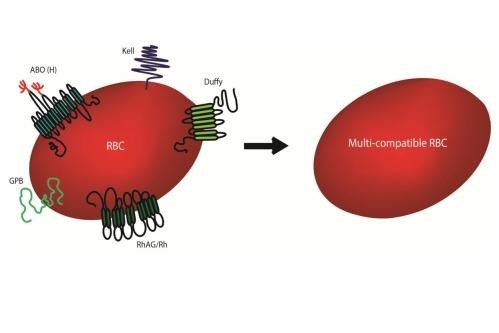
The team then went on to and created cells that combined the deleted multiple blood groups in a single cell line that could be differentiated to create red blood cells with extreme broad transfusion compatibility. By transfusing these edited cells, patients with blood disorders could experience better treatments.
The authors note that there is still much work to be done before this approach could be translated into a clinical product, but does open up a door for hope.
 "Blood made using genetically edited cells could one day provide compatible transfusions for a group of patients for whom blood matching is difficult or impossible to achieve within the donor population. However, much more work will still be needed to produce blood cells suitable for patient use," said Ashely Toyle, Director of the Bristol NIHR BTRU.
Image: Synthetic biologists at the University of Bristol have succeeded in generating laboratory-made red blood cells with rare blood group types. Image courtesy of Ashely Toyle at the University of Bristol.