Group 2 innate lymphoid cells (ILC2) are immune cells known to release inflammatory cytokines in response to agents such as parasites, viruses, and allergens. The cytokine release can lead to increased mucus production and muscle contractions, expelling the agents. Too much or prolonged inflammation is detrimental, however, so a means of dampening the response is important. A recent discovery now finds such a regulatory system through the signaling between neurons and the ILC2. A Weill Cornell Medicine-led team of researchers detail their new findings in Science.
 "There is a crosstalk between the nervous system and the immune system, and that plays an important role in regulating acute and chronic inflammation," says senior study co-author David Artis. "Those two organ systems are closely interacting and play an important role in human health and disease."
In experiments with mice infected with helminth parasites, the team found that intestinal ILC2s expressed β2 adrenergic receptors (β2AR). Because β2AR normally responds to neurotransmitter epinephrine (or adrenaline) released from neurons, the receptors thus confer the ability for immune cells to interact with the nervous system.
When β2AR was inactivated, the mice responded with production of more ILC2s, eosinophils, and type 2 cytokines, and less parasites were observed. On the other hand, β2AR stimulation by drugs led to reduced proliferation of ILC2s and more worm burden. The team’s paper concluded that “β2AR negatively regulates ILC2-driven protective immunity.”
"We found that those beta-adrenergic receptors controlled the proliferation of the ILC2 cells,” reported first author Saya Moriyama, noting that the receptors may help dampen inflammation.
It turns out, the most commonly used drugs to treat asthma also stimulate β2AR, and that may explain why they are so effective at controlling allergy symptoms. "We must have given tens of millions of doses of these drugs to shut down the acute symptoms of asthma," says Artis.
“Nobody could agree on how these drugs work, but it may be that they are working in part through targeting the innate immune system,” he adds. “If we understand more mechanistically how this class of drugs works, it might give us new avenues to develop additional therapies built around the biology."
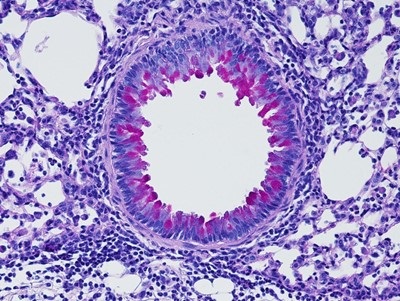
Image: Mucus production (red) in the lung under under inflammatory conditions. Image courtesy of Saya Moriyama.