A Princeton University laboratory has confirmed that they have designed and built a protein that can fold and mimic other proteins required for living. The findings were published earlier this week in Nature Chemical Biology.
Michael Hecht's team created a strain of Escherichia coli (E. coli) that was missing the enzyme Fes, without which it cannot release the iron from enterobactin. "We all need iron," Hecht said. "Even though iron is abundant on earth, biologically accessible iron is not."
The cells had no way of taking in iron. When the researchers tried providing the E. coli iron, the cells were stained red. This meant that the cells did not take the iron in and break it down. It wasn't until the team provided the E. coli their artificial Syn-F4 enzyme that they could take up the iron and the cells no longer appeared red.
"One is for the life that remains to be discovered on Earth. Perhaps one day, we'll find a natural enzyme that looks like Syn-F4 but takes the place of Fes in some microorganism or other. At least now, we'll know to look. Another implication is for astrobiology. If there are many equally likely solutions to a biochemical problem, it becomes more likely that a solution has been found elsewhere in the universe." said Wayne Patrick, a senior lecturer in biochemistry at the University of Otago.
"We're starting to code for an artificial genome. We've rescued 0.1 percent of the E. coli genome. ... For now, it's a weird E. coli with some artificial genes that allow it to grow. Suppose you replace 10 percent or 20 percent. Then it's not just a weird E. coli with some artificial genes, then you have to say it's a novel organism." said Hecht.
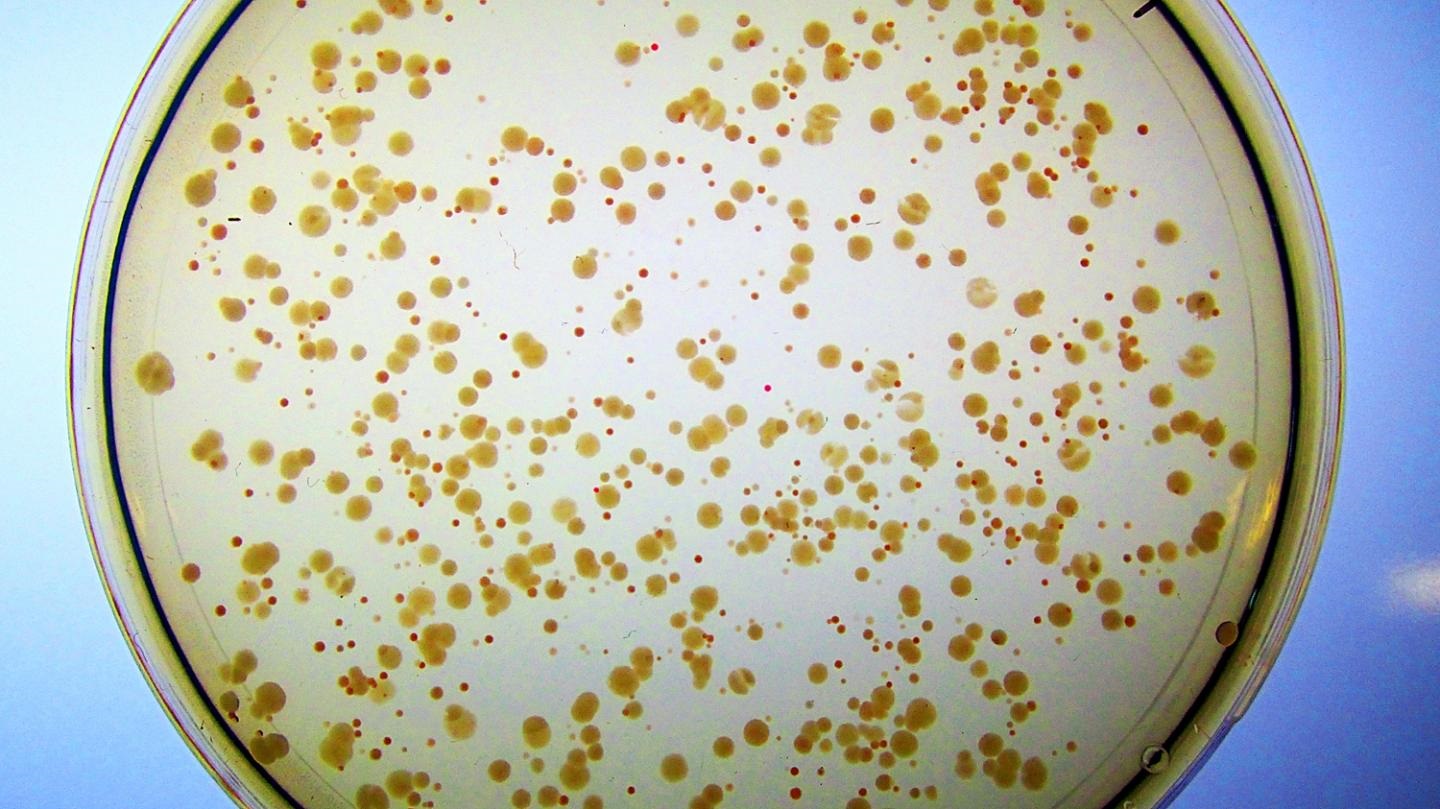 Image: Colonies of E. coli grow on iron-rich medium. All cells were engineered to lose their natural Fes enzyme. They form small, unhealthy red colonies because they accumulate iron bound to enterobactin, and barely have enough free iron to grow. In contrast, cells containing the artificial enzyme Syn-F4 form large, healthy white colonies because the novel protein catalyzes the cleavage of enterobactin and subsequent release of the iron needed for healthy growth. (Note: If these cells were placed on petri dishes with minimal iron, the red colonies would not appear at all because they would not have enough free iron to sustain cell growth.) Image courtesy of Ann Donnelly/Hecht Lab/Princeton University.