In many labs, scientists use fluorescent proteins for bioimaging. However, many fluorescent proteins come with limitations and can't endure low pH environments. In this current study, researchers from Osaka University have designed and developed an acid-tolerant monomeric green fluorescent protein (GFP). The work was published recently in Cell Chemical Biology.
"Although there are reports of several acid-tolerant green fluorescent proteins, most have serious drawbacks. Furthermore, there is a lack of acid-tolerant GFPs that are practically applicable to bioimaging," says Hajime Shinoda, lead author of the study. The researchers newly developed GFP is called Gamillus.
Gamillus is a GFP cloned from Olindias formosa. It can tolerate a pKa as low as 3.4 and is almost twice as bright as compared to some other GFPs. The fluorescence spectrum is constant between pH 4.5 and 9.0, which falls between the intracellular range in most cell types. Using x-ray crystallography and point mutagenesis, the group found that Gamillus' high tolerance to acid is thanks to its chemical structure.
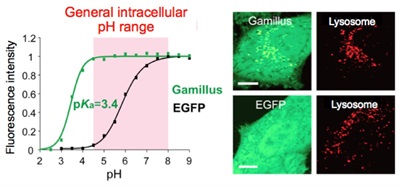 "The applicability of Gamillus as a molecular tag was shown by the correct localization pattern of Gamillus fusions in a variety of cellular structures, including ones that are difficult to target," corresponding author Takeharu Nagai says. "We believe Gamillus can be a powerful molecular tool for investigating unknown biological phenomena involving acidic organelles, such as autophagy."
Image: (Left) pH-dependent fluorescence property of Gamillus and EGFP. (Right) Fluorescence images of HeLa cells expressing Gamillus or EGFP. Gamillus enables fluorescence observation of protein migration to lysosomes caused by macroautophagy. Scale bar, 10 μm. Image courtesy of Osaka University.