The membranes of biological cells provide a diverse lipid environment that can affect the structure and function of residing membrane proteins. However, not much is known about the roles that such lipids may play in modulating protein-protein interactions. A Texas A&M University team of researchers, using native mass spectrometry, has examined how lipid-binding to a membrane protein may influence such interactions with other proteins.
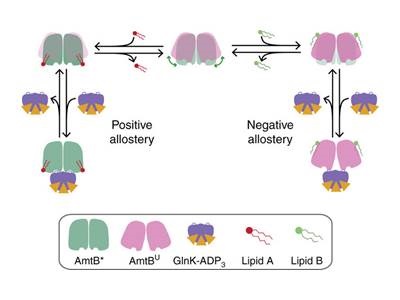 The team studied the E. coli ammonium channel protein (AmtB), an integral membrane protein, and its regulator GlnK. Glnk binds AmtB by blocking its channel depending on the nitrogen status of the cell. To investigate the effects of lipid binding to the AmtB-GlnK interaction, the team recorded native MS spectra for the protein complex in the presence of different lipids. Native MS was used due to its ability to preserve non-covalent interactions, enabling investigation of individual lipid-binding events.
According to their recently published paper in Nature Communications, the team found that addition of various lipids to AmtB and GlnK resulted in lipids binding to both the AmtB protein as well as the AmtB-GlnK complex. More importantly, no lipid-binding events to GlnK were observed indicating that the binding is specific to AmtB and AmtB-GlnK.
The team also finds that lipids with different headgroups and tail groups bind at different affinities to the complex. These may be attributed to certain moieties in the headgroup that support binding of the lipid to either a unique site or binding mode within AmtB, which in turn would enhance binding to GlnK. Lipid tail length appeared to exhibit specific requirements for allosteric modulation. Lengths of 12 and 16 were more favorable than a length of 14.
In summary, these mass spectrometry-based results show how individual lipid-binding events can influence integral membrane protein and soluble protein interactions. The paper concludes that this finding “is the first report demonstrating that individual lipid-binding events can have a large dependence on the chemistry of the lipid in modulating membrane protein structure and function.”
Image: A plausible model for the allosteric modulation of the AmtB–Glnk by individual lipid-binding events. Image courtesy of Arthur Laganowsky and Springer Nature.