Overexpression of a protein that regulates calcium homeostasis in hippocampal neurons can safely and effectively reverse and prevent age-related memory impairments in rats while restoring altered gene expression, according to new research from the University of Kentucky published yesterday in the Journal of Neuroscience.
Philip Landfield, John Gant, Eric Blalock and colleagues found that long-term and short-term treatment of aging rats that induces overexpression of FK506-Binding Protein 12.6/1b (FKBP1b) restored the expression of more than 800 genes affected by aging to levels comparable to those of young untreated rats.
In addition to reducing memory deficits in aged rats, FKBP1b selectively counteracted aging-induced expression changes in 37% of aging-dependent genes, with cytoskeletal and extracellular structure categories highly associated with the FKBP1b-rescued genes.
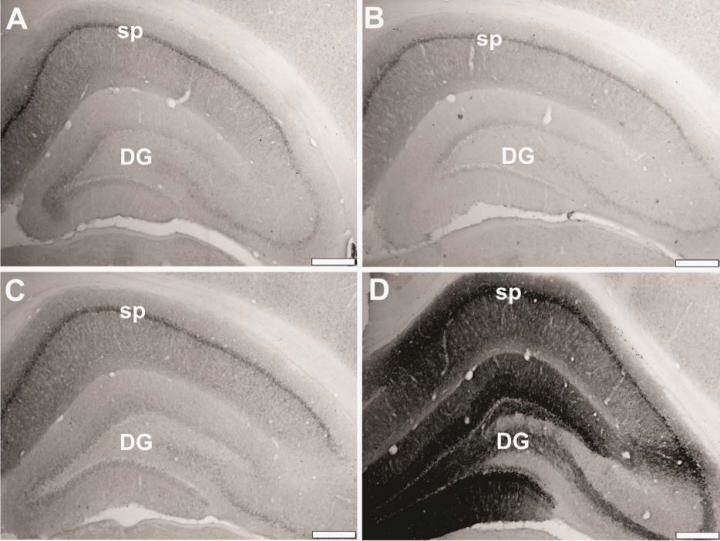
The restored genes represent a new genomic network that regulates the integrity of neuronal structure in the hippocampus and is targeted by aging. These results suggest that addressing FKBP1b deficiency may represent a new avenue for countering age-related memory loss.
Image: Representative photomicrographs from (A) young control, (B) aged control, (C) aged short-term FKBP1b and (D) aged long-term FKBP1b. Note the substantial increase in FKBP1b expression at both the mRNA and protein levels, particularly in the LT-FKBP1b group. (sp- stratum pyramidale; DG- dentate gyrus; calbar- 500 uM). Image courtesy of Gant et al., JNeurosci (2017).