 Researchers have determined how melanoma cells bypass the blockade that combination drug therapies create and then continue to spread using parallel pathways. The study appeared in Nature yesterday from researchers at the University of Pennsylvania and The Wistar Institute.
"The tumor cells are smart," said Wei Guo, Ph.D., co-corresponding author on the study and a professor of biology in Penn's School of Arts and Sciences. "Once they block this first pathway, then other pathways can get activated, leading to an even more aggressive disease."
"Our findings provide a possible flanking strategy to counteract the ability of melanoma cells to re-wire their signaling networks," said co-coresponding author Meenhard Herlyn, D.V.M., D.Sc., Caspar Wistar Professor in Melanoma Research and director of the Melanoma Research Center at The Wistar Institute. "When cancer gets smart, we have to act even smarter."
About 50% of melanomas are attributable to a mutation in the BRAF gene. When BRAF is mutated, the enzyme acts on the MAP/ERK pathway and there is an increase in cellular growth, a classic sign of cancer. Currently, there are therapies that target the BRAF, but it still isn't completely successful.
Since it is not a completely successful therapy, researchers created drugs to block enzymes that act downstream of BRAF/MEK. However, even when paired with drugs that target just BRAF, the effectiveness has been transient.
So the researchers wanted to find how this resistance occurred in melanoma cells. To do this they examined both cell lines and tumor biopsies from melanoma patients before and after either BRAF inhibitor therapy or BRAF/MEK inhibitor combination therapy. Like past studies have shown, the treatment with BRAF inhibitors alone seemed to reactivate ERK, which is downstream of BRAF in the MAPK pathway.
However, in many cell lines and patient samples, the researchers saw that a resistance to the combination therapy developed and it was not ERK that was reactivated. Instead, they found that a parallel pathway, governed by the enzyme PAK, was energized.
"We found not only was PAK activated in many patients, but also PAK's downstream targets," Guo said.
So the researchers tried treating the cells resistant to the combination therapy with a PAK inhibitor and sure enough, they saw that it reduced the melanoma cells' ability to grow. When the researchers did the opposite, turning on a PAK protein in a metastatic melanoma cell line, they found the cells became even more resistant to inhibitors of the MAPK pathway.
In previous studies, researchers found that when they blocked PAK, they found it to do nothing to stop melanoma progression.
"It seems it is only when the ERK pathway is inhibited that PAK becomes 'awake,'" Guo said. "Then you can apply the PAK inhibitor and see an effect."
The group believes that their discovery might direct new drug development efforts.
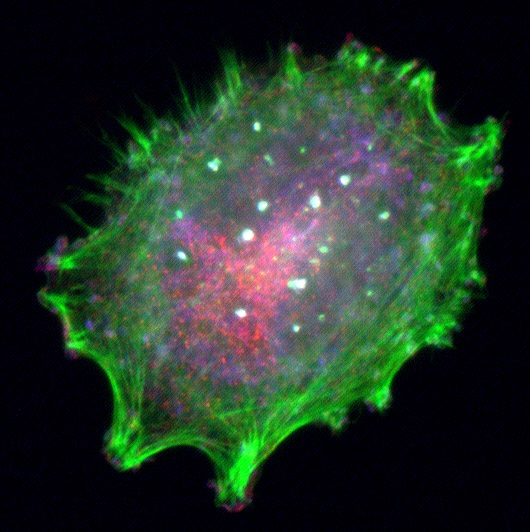
Image: An immunofluorescence image of a melanoma cell stained with antibodies against the cytoskeleton components indicate their invasion into surrounding matrix. Image courtesy of Yueyao Zhu and Wei Guo.